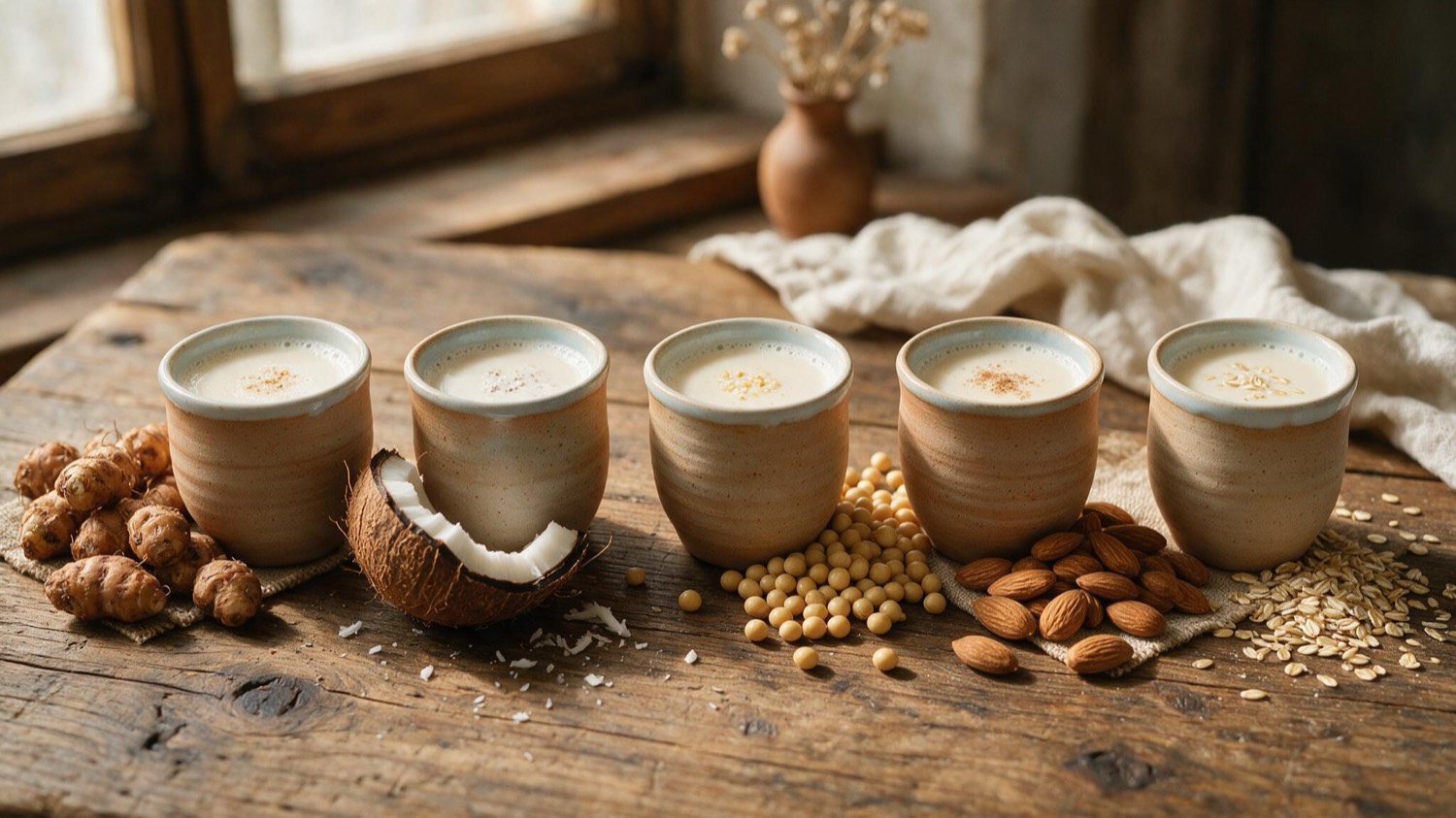
Walk into any supermarket and you'll be told a story: that plant milk is new. A trend. An "alternative" that arrived sometime around the launch of the flat white. It's a tidy narrative, and it happens to be wrong by roughly five millennia.
Long before a barista ever asked "oat or almond?", people across four continents were soaking, grinding and pressing plants into pale, nourishing liquids they drank, cooked with and buried alongside their dead. Plant milk was not humanity's Plan B. For most of the world, for most of history, it was simply milk — or something close enough that nobody felt the need to apologise for it.
Here is the deeper story, told through five plants and the people who loved them.
Egypt's tiger-nut: the original horchata
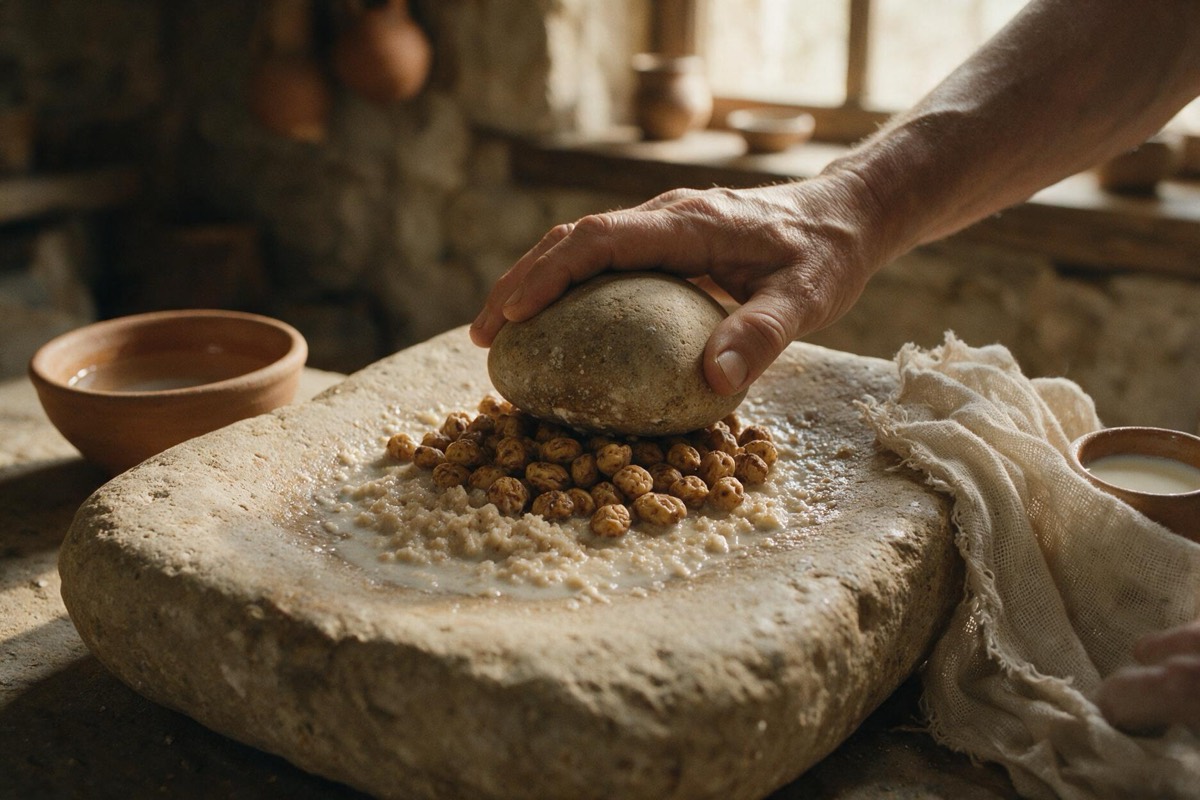
Start on the banks of the Nile. The tiger-nut — chufa, the tuber of a stubborn sedge called Cyperus esculentus — is one of the oldest cultivated foods in Egypt, grown by around 5,000 BCE and ranking just behind emmer wheat and barley in importance. People had been gathering it wild for far longer; charred tubers turn up at Wadi Kubbaniya in Upper Egypt from some 16,000 years ago.
The Egyptians adored it. Archaeologists have recovered tiger-nuts from tombs more than 4,000 years old, tucked in as provisions for the afterlife, and a wall painting in the tomb of the vizier Rekhmire (around 1450 BCE) shows servants grinding the sweet tubers into ritual cone-cakes. As food writer at NPR's The Salt puts it, this loathed modern weed was an ancient delicacy.
Soaked and pressed, tiger-nuts give up a milky, almost cinnamon-sweet liquid — and that liquid never really went away. Carried into the Arab world (where it became habb al-aziz) and then into Spain by the eighth century, it survives today as horchata de chufa, the milky-white drink documented in Valencia by the thirteenth century and still sold on street corners there. A 5,000-year-old smoothie, in other words, that outlived the pharaohs. (We tell its full story in the horchata article.)
The Pacific's coconut: milk that crossed an ocean
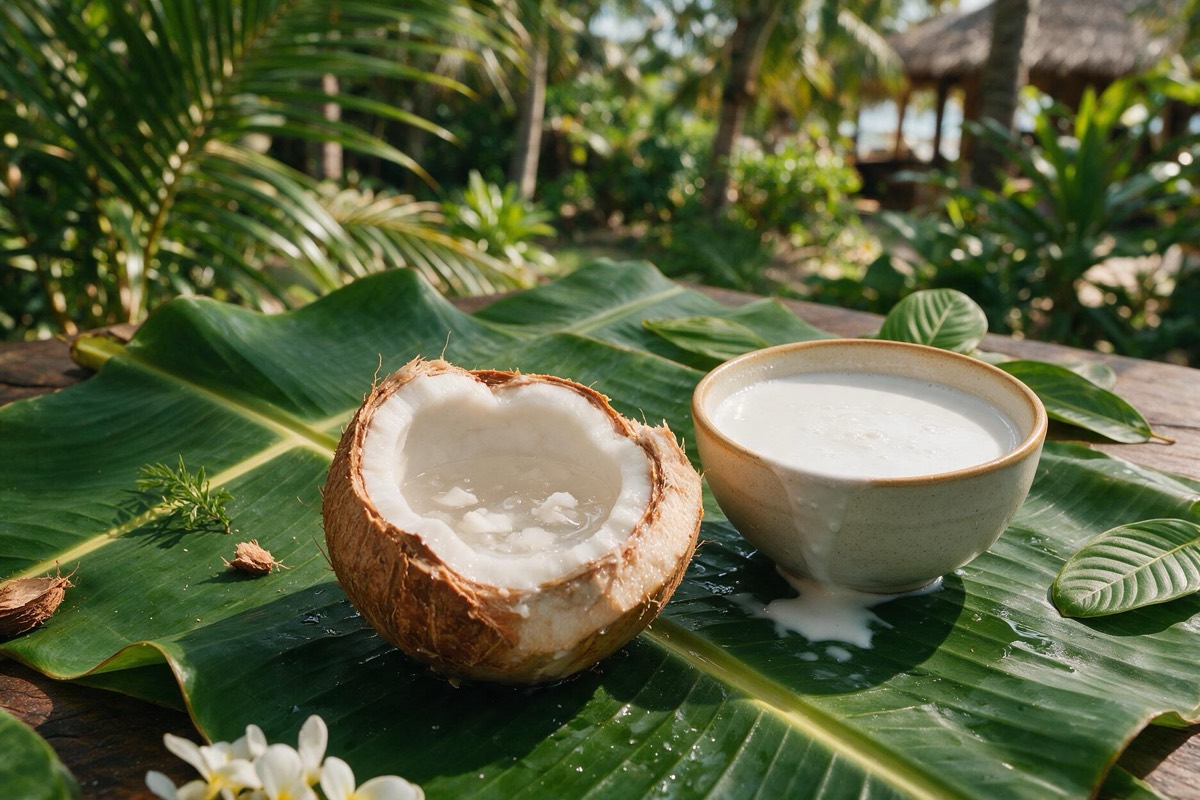
Now sail east. Somewhere in Island Southeast Asia, Neolithic seafarers domesticated the coconut and then took it with them across the largest ocean on Earth. During the great Austronesian expansion — roughly 3500 to 2000 BCE — outrigger canoes carried coconuts (along with taro, banana and breadfruit) as far east as the remote Pacific and as far west as Madagascar.
Genetic detective work on more than 1,300 coconuts confirms two separate domestications, one in the Pacific basin and one around the Indian Ocean. Wherever the palm went, grated flesh pressed with water became the backbone of the kitchen — the coconut milk that still enriches curries, puddings and sauces across the tropics of Oceania and South Asia. This was never an imitation of dairy. In much of the world it was the cream. More on that in the coconut story.
Han China's soybean: the accidental milk
Travel north to China, and to a bean. Soy milk — doujiang, literally "bean broth" — began not as a drink in its own right but as a step on the way to tofu: soybeans soaked, ground and strained into a milky extract, then coaxed to curdle. The earliest solid reference appears around 82 CE, in the writings of the Han-dynasty sceptic Wang Chong, and an Eastern Han stone relief even depicts the grinding in progress.
You may have heard that a prince named Liu An invented tofu in 164 BCE. It's a good tale, but as the meticulous historians at the SoyInfo Center point out, the claim first surfaces roughly a thousand years later, and scholars have given up on it. What we can say is that East Asia has been drinking soy milk, warm and often faintly sweet, for the better part of two thousand years — a fact worth remembering next time someone calls it futuristic. The soy milk story has the full picture.
The medieval world's almond: milk for the fast
Which brings us to the Middle Ages, and to a plant milk that briefly conquered Europe. Almond milk appears in Arabic cookery manuscripts from the ninth century — the scribes wrote of "milking almonds" — and features in the thirteenth-century Baghdad cookbook al-Baghdadi. From the kitchens of the caliphs it travelled west through Al-Andalus and, by the 1300s, into nearly every grand European cookbook: England's Forme of Cury, Germany's Das Buch von Guter Spise.
The obsession was partly practical. As Atlas Obscura explains, medieval Lent was closer to a vegan fast than the modern "no meat on Fridays" — dairy, eggs and animal milk were off the table for long stretches of the calendar. Almond milk didn't spoil like cow's milk, could be drawn thick or thin, and carried an unmistakable whiff of luxury; King Edward I's household got through it by the hundredweight. For a few centuries, as one historian notes, Europe's elite were, without ever calling it that, plant-milk devotees. We linger there in the almond-milk article.
Oat: the newcomer that felt like coming home
And oat milk? The baby of the family. It was invented in the 1990s by Swedish food scientist Rickard Öste at Lund University, who — fittingly for our next story — was researching lactose intolerance. His team's patented enzyme process turned oat starch into something naturally sweet and pleasingly milk-like; a working prototype arrived in 1993, and Oatly was founded in 1994. Within a generation it had swept the world's coffee shops. Its tale is here.
Never an "alternative"
Line these five up — tiger-nut, coconut, soy, almond, oat — and the modern framing collapses. Four of the five predate the industrial dairy that now claims to be the default. Across Egypt, the Pacific, China and the medieval Mediterranean, pressing a drinkable milk from a plant wasn't a lifestyle statement or a substitute for anything. It was ordinary human ingenuity, repeated independently, again and again, wherever people had a hard seed, a fibrous tuber or a fatty nut and a bit of water.
Which raises an awkward question the dairy aisle would rather you didn't ask: if plant milk is the alternative, alternative to what? For most of humanity, as we explore in the science of who can actually digest milk, the answer isn't as obvious as it looks.
Ready to see how deep these roots run? Spin the heritage globe to trace each of these milks back to its home soil — or head to the recipes and taste five thousand years of history for yourself.