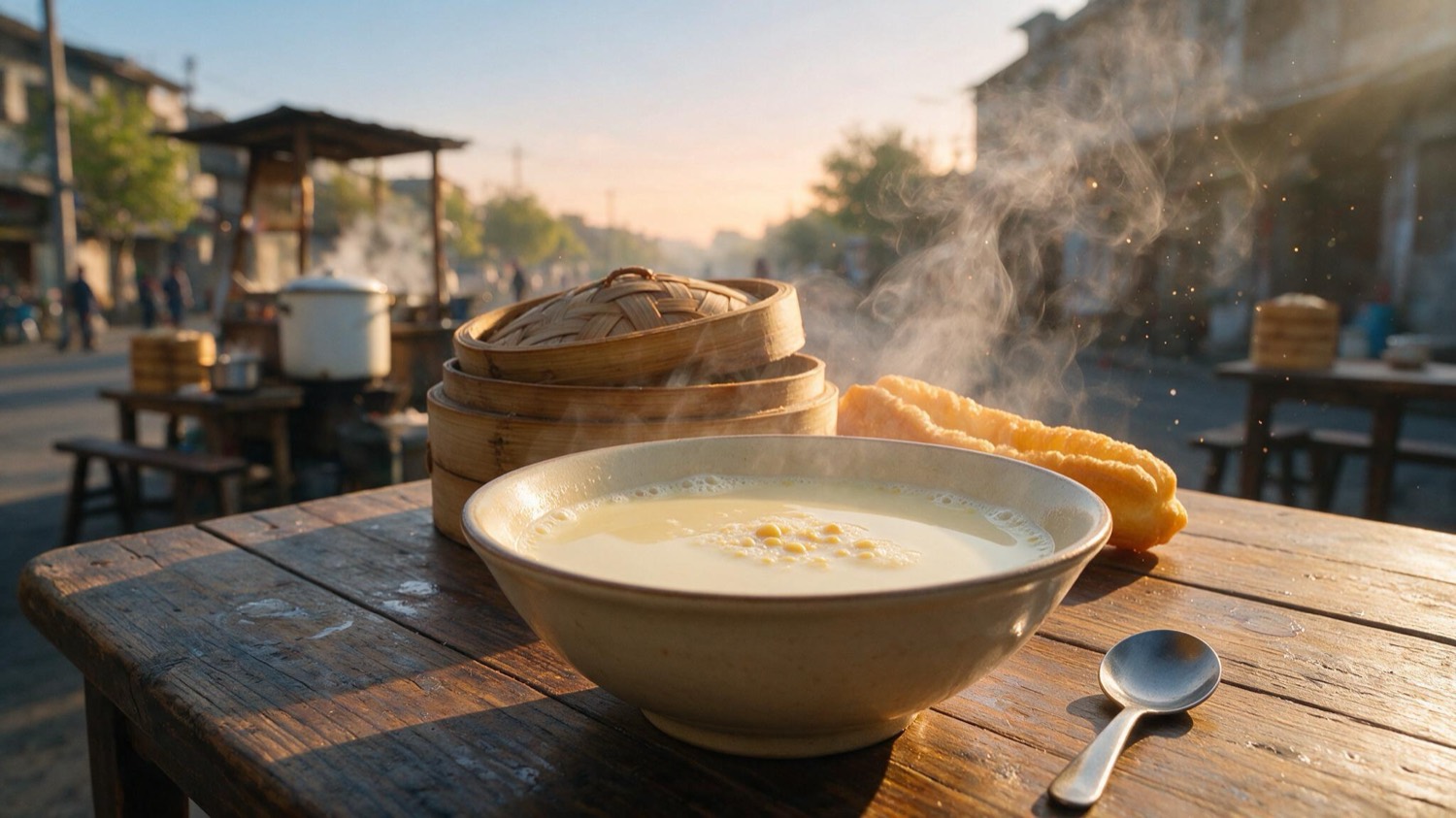
Somewhere in China, most likely during the Han dynasty, someone soaked a handful of soybeans overnight, ground them to a pale slurry, strained the pulp and warmed the liquid that ran through the cloth. It smelled green and faintly nutty. They had no word for "plant milk" and no marketing department. They had, without quite meaning to, invented one of the most successful drinks in human history.
Two thousand years later that same milky extract — the Chinese call it doujiang, "bean broth" — is poured over breakfast tables from Taipei to Toronto. Its story runs through alchemists, tomb carvings, medical missionaries and a surprisingly stubborn myth about hormones. And of all the plant milks, it has the best claim to sit beside cow's on nutritional terms. Let's follow the bean.
A prince, an elixir, and a legend that won't die
Ask who invented soy milk and you'll usually be pointed to Liu An, a Han prince and grandson of the dynasty's founder, tinkering with his court alchemists on Mount Bagong around the 2nd century BCE. The story goes that, while hunting for an elixir of immortality with soybeans and gypsum, they curdled the beans by accident and produced tofu instead — with soy milk as the obvious intermediate step.
It's a great tale. It's also almost certainly not true. As food historians note, the Liu An attribution first surfaces in writing only in the late 1500s, roughly 1,700 years after the prince's death, in the great pharmacopoeia of the naturalist Li Shizhen — and even then Li credited Liu An with tofu, not soy milk. Later writers, East and West, promoted the prince to inventor of the drink too. It's a reminder that the tidiest origin stories are often the youngest.
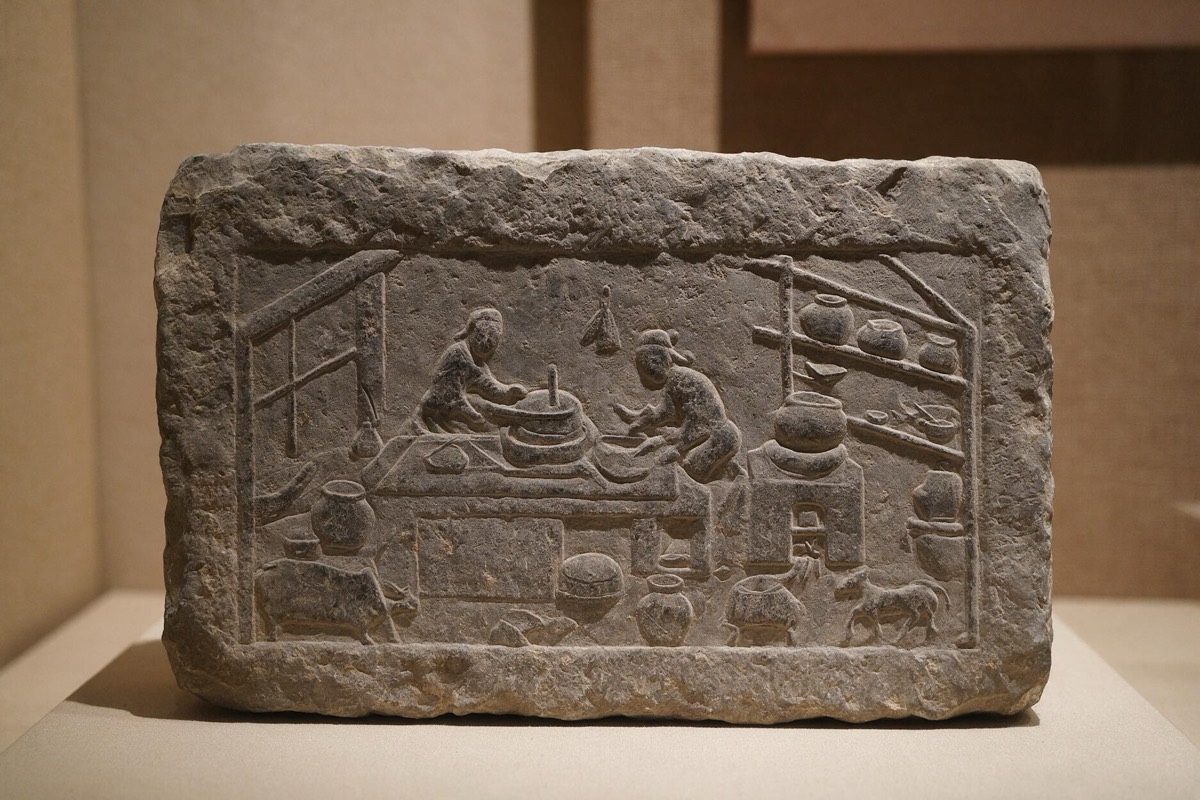
The sober evidence is humbler and, to my mind, more interesting. The earliest textual traces of the bean broth appear in the Han era, and there is a tantalising piece of stone: a carved slab from an Eastern Han tomb at Dahuting, in Henan, that is frequently cited as an early depiction of soy-food production — figures grinding, filtering and pressing at what looks a great deal like a tofu kitchen. Frequently cited, but not settled: some scholars read the same scene as brewing rather than bean-curd making. History, as ever, refuses to sign the receipt.
Doujiang: the breakfast that built a habit
Whoever first made it, soy milk found its true home not in the elixir cabinet but at the breakfast stall. Across China, a bowl of hot doujiang — sometimes sweet, sometimes savoury and clotted with vinegar, soy sauce, pickles and chilli oil into the dish called xian doujiang — remains the archetypal morning meal, ideally with a youtiao (a fried dough stick) for dunking. It's fast, cheap, filling and everywhere: the congee's liquid cousin.
Soy milk and tofu grew up together, two products of the same simple process: grind, strain, and either drink the liquid or coagulate it into curd. That kinship let soy travel as a system rather than a single item. As Buddhism spread and its vegetarian kitchens looked for protein without slaughter, the soybean's versatility made it indispensable, and doujiang, tofu, soy sauce and fermented bean pastes moved together into Japan, Korea and Southeast Asia. Japan got its tōnyū and its silken tofu; Korea built entire soups, like kongguksu's chilled soy-milk noodle broth, on the drink. Long before anyone in Europe had heard of it, soy milk was a continental staple.
How the bean reached the West — via the mission field
Soy milk's arrival in the West is a genuinely odd chapter, and it runs largely through the Seventh-day Adventist church, whose vegetarian theology made it an unlikely engine of plant-based food science. Adventist entrepreneurs were among the first Westerners to make soy foods commercially: T. A. Van Gundy launched La Sierra Soy Milk in California in November 1929, reportedly the first Adventist anywhere to sell the drink commercially.
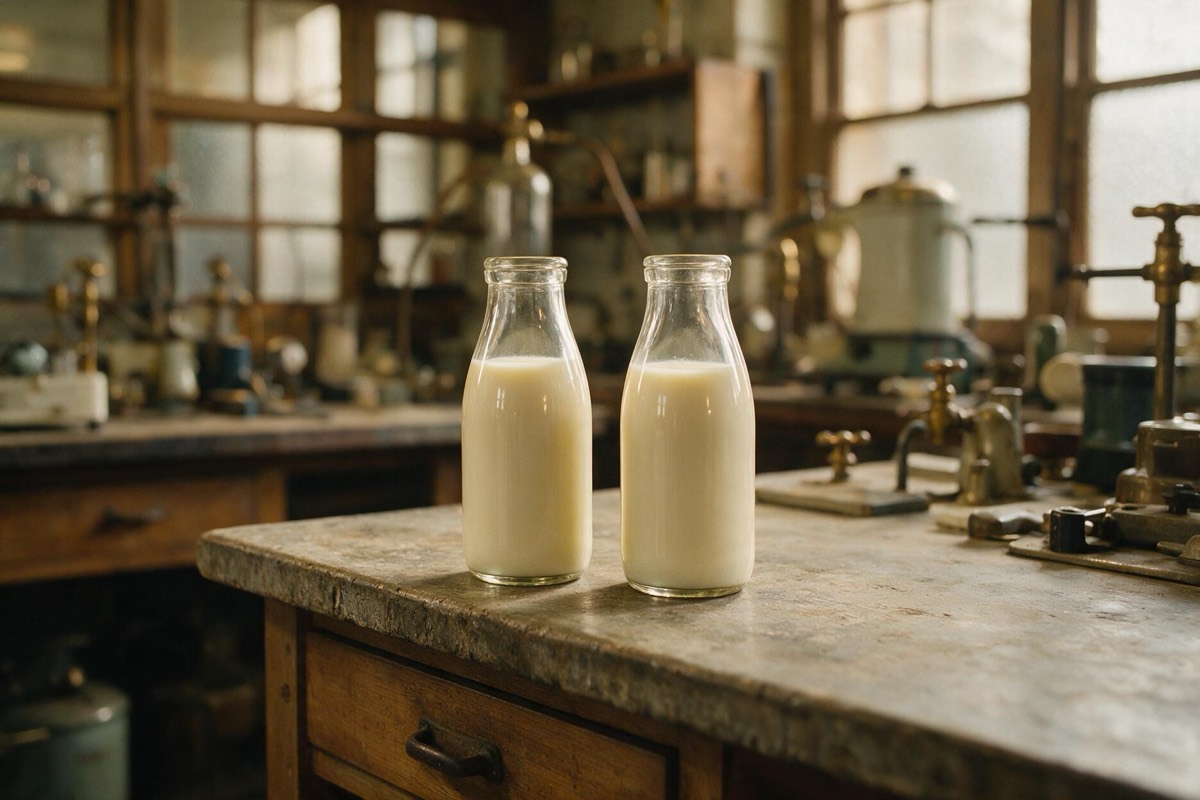
The towering figure, though, is Dr Harry W. Miller (1879–1977) — surgeon, medical missionary and self-taught food engineer. Working in China, Miller set out to solve soy milk's two great problems: its "beany" flavour and its poor digestibility, chiefly so it could feed infants who couldn't tolerate dairy. By 1936 he was bottling Vetose Soya Milk, plain and chocolate, from his laboratory in Shanghai. War and revolution eventually pushed him back to the United States, where his methods fed into the Adventist-run Loma Linda Food Company — to which he sold his soy-processing plant in 1950. The tinned and powdered soy milks that seeded the modern industry owe a real debt to a missionary who thought a better bean drink might do some good in the world.
The plant milk that stands closest to cow's
Here's soy's real advantage. Among the plant milks, it comes nearest to dairy on the measure that matters most to many people: protein. Unsweetened soya drink carries roughly 3.3g of protein per 100ml against cow's milk's 3.4g — and, unusually for a plant, that protein is complete, supplying all the essential amino acids. It's why UK dietitians treat fortified soya as the go-to dairy swap, and why the British Dietetic Association rates soya drinks as a very good source of protein, unsaturated fat and — when fortified — calcium, iodine and B12. If you want the full swap-it-in-your-tea rundown, our dairy-free tips page has you covered.
And the hormones? Let's put the old worry to bed properly. Soy contains isoflavones, plant compounds sometimes labelled "phytoestrogens" because they can weakly interact with oestrogen receptors. "Weakly" is the operative word: they are structurally quite unlike human oestrogen and far less potent. Large reviews, including from Oregon State University's Linus Pauling Institute, find that ordinary soy intake does not raise oestrogen in women or lower testosterone in men, and — far from the scare stories — higher soy consumption is generally linked to *lower* breast-cancer risk, not higher. The man drinking soya in his flat white is not, it turns out, living dangerously.
From a Han kitchen to a Shanghai bottling line to the chiller cabinet of your local shop, soy milk has fed people for two millennia — no elixir of immortality required, though for a humble strained bean broth it has made a fair run at living forever. Curious where else the plant-milk story travels? Spin the heritage globe, or take the 7-Day Challenge and let breakfast do the talking.