One swap,
a lighter planet.
How does your glass of milk land on the planet? ProVeg International's Plant Milk Report ran the numbers — emissions, land, water, wildlife — and every figure is cited below.
Small glass. Big footprint gap. ♡

Our planet section is proudly supported by ProVeg International (find out more)
Emissions: three times lighter
A litre of cow’s milk carries roughly three times the greenhouse gases of a litre of soya milk.
The per-litre numbers
Cow’s milk comes in at 3.2 kg CO₂eq per litre. Almond sits at 0.7, oat at 0.9 and soya at 1.0 — every plant milk lands far below dairy.
ProVeg Plant Milk Report · Poore & Nemecek 2018, Science
The bigger picture
The livestock sector is responsible for around 16% of human-made greenhouse gas emissions, with cattle producing most of it — beef and dairy herds in roughly equal measure.
ProVeg · FAO GLEAM · IPCC AR5
The methane multiplier
Dairy’s warming problem is mostly methane — fast, potent, and fixable.
80× more potent
Methane is about 80 times more powerful than CO₂ over a 20-year window, and farmed animals are responsible for 32% of human-made methane emissions.
ProVeg · IPCC AR6 · Crippa et al. 2021
Proven at farm level
A Swedish farm study found that switching production from cow’s milk to oat drink cut greenhouse gas emissions by 16–41% — driven by reduced methane from ruminants.
ProVeg Plant Milk Report · Röös et al. 2016, Agricultural Systems
Land: about 12× less
A litre of cow’s milk needs roughly twelve times more land than a litre of soya milk — and all the plant milks sit similarly low.
9 m² per litre
Producing a single litre of cow’s milk takes about nine square metres of land. Every plant milk variety ProVeg compared uses a similarly small fraction of that.
ProVeg Plant Milk Report · Poore & Nemecek 2018, Science
What livestock takes
Livestock farming occupies nearly 80% of the world’s agricultural land — while providing less than 20% of the world’s calories.
ProVeg · Poore & Nemecek 2018 · Our World in Data
Water: 628 litres per litre
The water bill for a litre of milk varies wildly — and dairy tops the table by a distance.
The thirsty one
It takes about 628 litres of water to produce one litre of cow’s milk. Soya milk needs 28 litres, oat milk 48.
ProVeg Plant Milk Report · Poore & Nemecek 2018, Science
Even almond wins overall
Almond is the thirstiest plant milk at 371 litres — still well under dairy — and it carries the lowest greenhouse footprint of the milks compared. ProVeg publishes the trade-off openly.
ProVeg Plant Milk Report · Mekonnen & Hoekstra 2012, Ecosystems
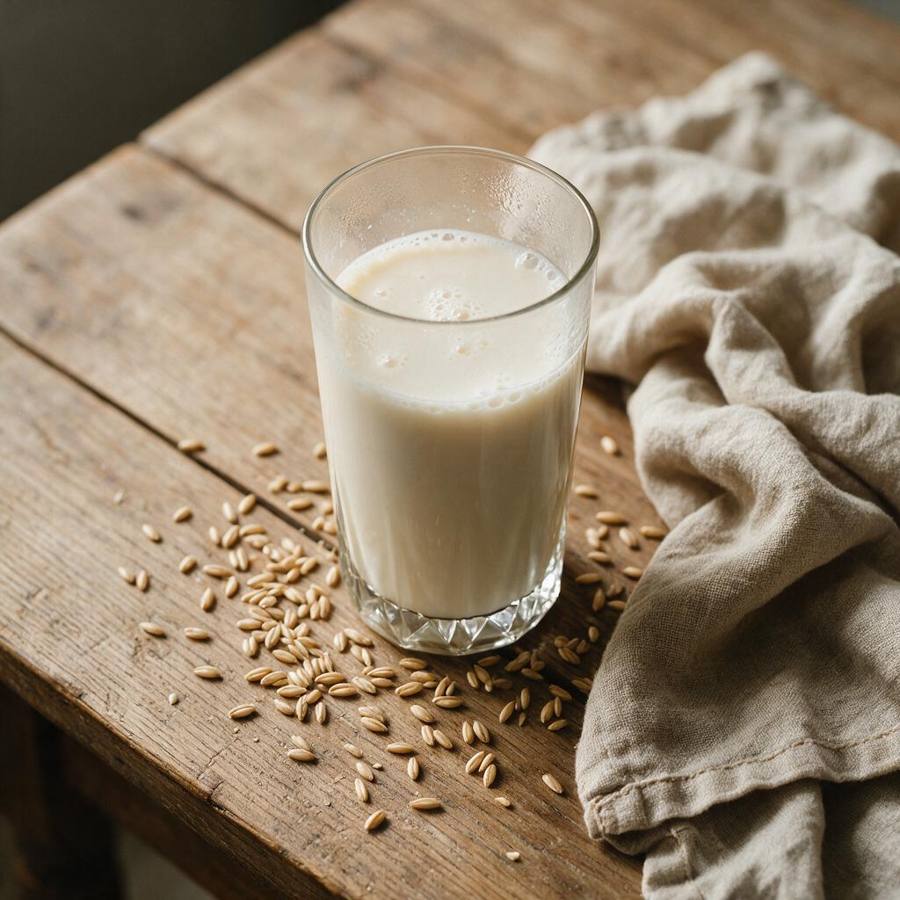
Oat and soy barely sip. ♡
Biodiversity: the soy plot twist
The pressure on forests and wildlife comes overwhelmingly from animal agriculture — including the soy story most people have backwards.
Who’s clearing the forest
Agriculture drove almost 90% of global deforestation between 2000 and 2018 — and about 76% of the world’s soy is grown as animal feed, not for foods like tofu or soya milk.
ProVeg · FAO 2022 · FAOSTAT
Wildlife, squeezed out
86% of species at risk of extinction are threatened by agriculture. Livestock now make up 58% of Earth’s mammal biomass; wild mammals are down to just 6%.
ProVeg · Chatham House 2021 · Greenspoon et al. 2023, PNAS
What one glass changes
Swap by swap, the numbers add up — here’s what the evidence says the change is worth.
63–78% smaller footprint
Some plant milks have a carbon footprint between 63% and 78% smaller than dairy milk.
ProVeg · Poore & Nemecek 2018, Science
Beyond carbon
Cow’s milk also scores worse than most plant milks on ecotoxicity, nitrogen footprint, eutrophication, acidification and biodiversity impact.
Röös et al. 2018, SLU / Food Climate Research Network
The direction of travel
Moving to a more plant-based diet could cut food-sector emissions by up to 50% and land use by up to 76%. A better glass of milk is the easy first step.
ProVeg Plant Milk Report · Poore & Nemecek 2018, Science
Ready to lighten the glass?
One litre at a time. Start with seven days.
Join the 7-Day ChallengeThe planet says thanks. ♡
Sources & citations
Content on this page is informed by the published work of ProVeg International and the sources they cite:
- The Plant Milk Report — ProVeg International, 2019
- The role of food systems in methane emissions — ProVeg International
- Deforestation — ProVeg International
- Soya and the environment — ProVeg International
- ProVeg calls on the EU to include plant-based milk in the EU's School Scheme — ProVeg International
- Plant-based milk in schools: science-based decisions, please — ProVeg International
- Poore J & Nemecek T — Reducing food's environmental impacts through producers and consumers — Science, 2018
- Röös E, Patel M & Spångberg J — Producing oat drink or cow's milk on a Swedish farm — Agricultural Systems, 2016
- Röös E, Garnett T, Watz V et al. — The role of dairy and plant-based dairy alternatives in sustainable diets (SLU/FCRN, 2018) — as cited in the ProVeg Plant Milk Report
- IPCC — Sixth Assessment Report, Working Group I — IPCC, 2021
- Crippa M et al. — EDGAR-FOOD emissions dataset — 2021
- Benton TG et al. — Food system impacts on biodiversity loss — Chatham House, 2021
- Greenspoon L et al. — The global biomass of wild mammals — PNAS, 2023
- Mekonnen MM & Hoekstra AY — A global assessment of the water footprint of farm animal products — Ecosystems, 2012
Figures on this page are drawn from ProVeg International's published work and the peer-reviewed sources they cite.
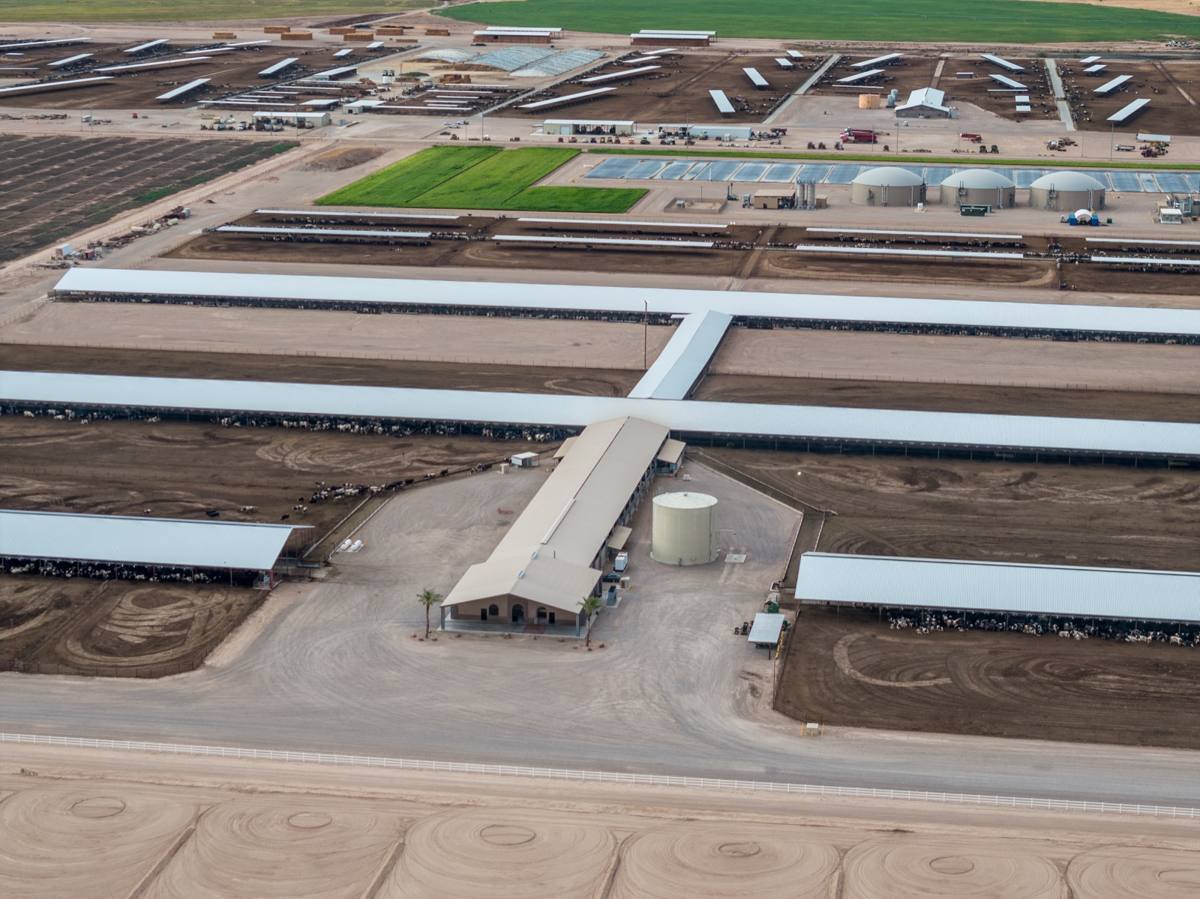
Aerial photograph courtesy of We Animals, used under their humane-education licence (credit under the image). Field and glass images are illustrative renders.