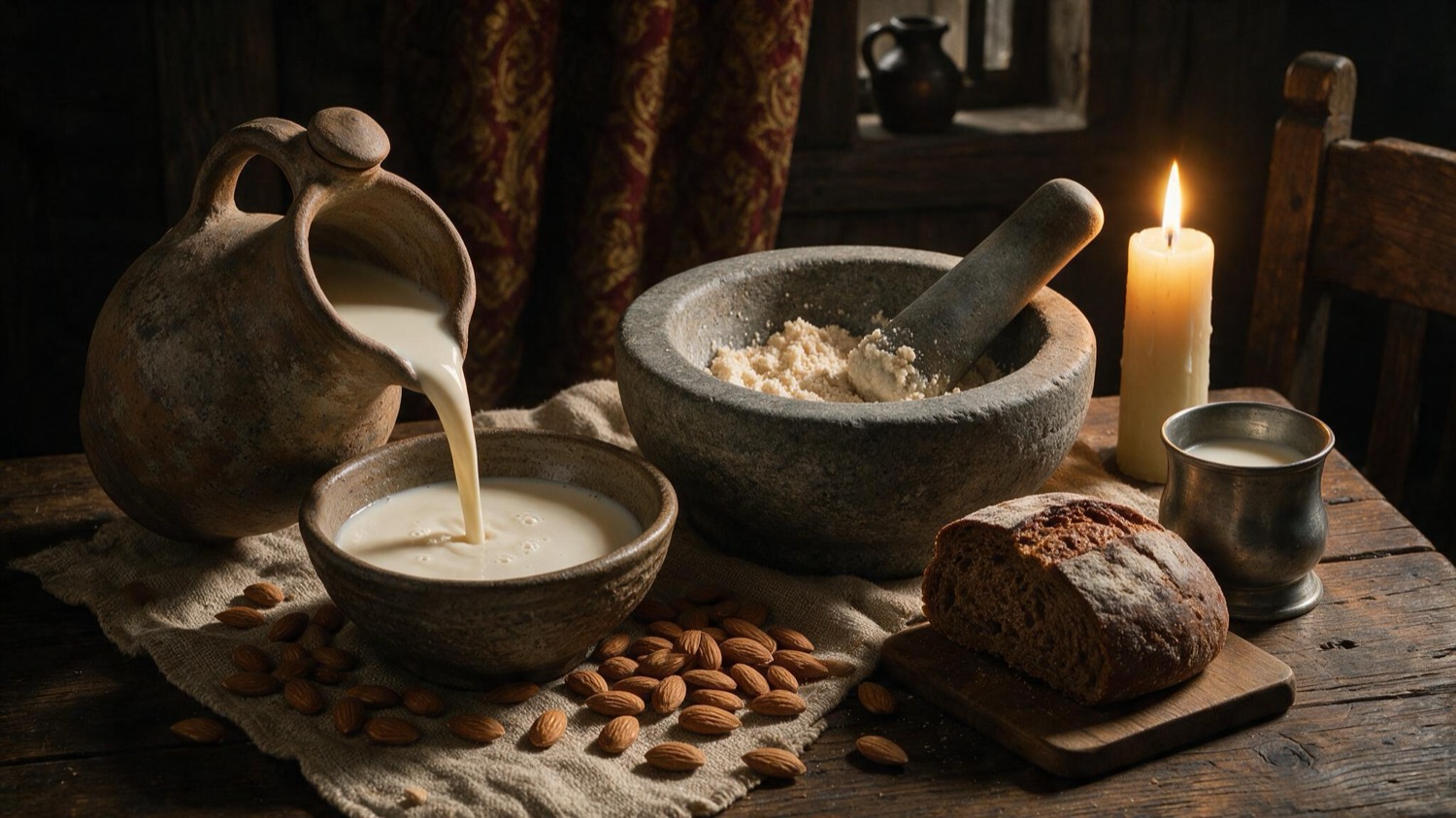
Imagine a kitchen with no fridge. No cold shelf, no ice beyond what you could haul down from a mountain, no way to stop a jug of cow's milk turning by lunchtime. Now imagine you also live under a religious calendar that bans dairy for something close to half the year. That was daily reality for the medieval cook, and it explains why, for roughly five hundred years, the most useful liquid in the European larder wasn't milk from any animal. It was milk squeezed from a nut.
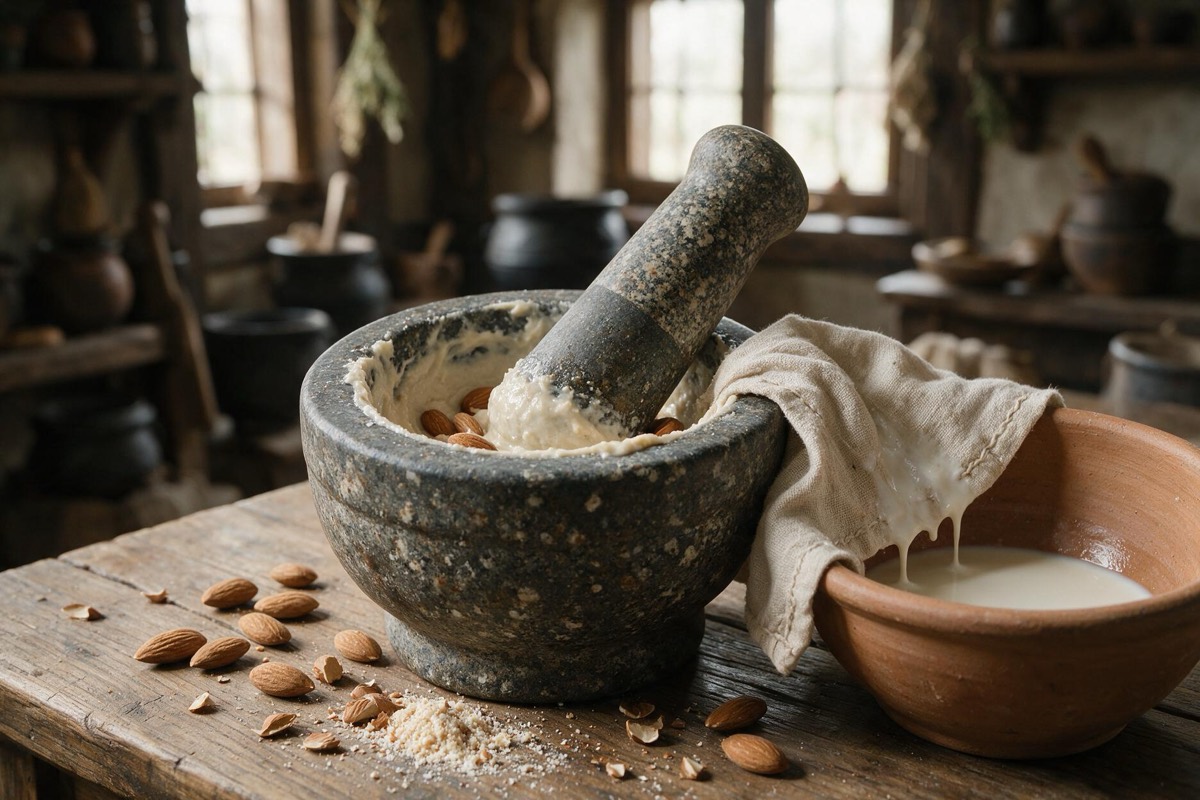
Almond milk was the quiet workhorse of the medieval kitchen: pounded almonds steeped in water and strained, producing a rich, pale liquid that behaved a great deal like dairy but broke none of the rules. It thickened sauces, enriched puddings, whitened dishes for the table and, crucially, it kept. In an age before refrigeration, that last quality was close to magic.
An invention of the caliphs' kitchens
The idea didn't begin in Europe at all. The earliest written recipes come from tenth-century Baghdad, in a sprawling cookbook called the Kitab al-Tabikh — "The Book of Dishes" — compiled by Ibn Sayyār al-Warrāq and running to more than six hundred recipes. As the International Vegetarian Union's history of almond milk records, the cooks of the Abbasid court treated almond milk as a luxurious staple, folding it into both savoury sauces and sweet puddings like mahallabiyya. Arabic had a whole vocabulary for it: halīb al-lawz, almond milk; māʾ al-lawz, almond water. The great physicians al-Razi and Ibn Sina prescribed it for weak stomachs and troublesome coughs; Ibn Sina's Canon of Medicine even recommended it for the skin.
From Baghdad the technique travelled the same westward road as sugar, citrus and so much else — through Islamic Spain, al-Andalus, and over the Pyrenees into the Christian kitchens of Europe. By the twelfth century it had arrived, and it was about to become indispensable.
The fast-day loophole
To understand why medieval Europe fell so hard for almond milk, you have to understand the medieval calendar. The Church built the entire year around fasting. There was Lent, the forty days before Easter. There was Advent. And there were the weekly fasts — traditionally Wednesdays, Fridays and Saturdays — on which the faithful were meant to abstain from meat, eggs and dairy. Add it all up and, by many reckonings, medieval Christians spent something close to half the year forbidden from touching a drop of cow's milk or a knob of butter.
This posed a genuine culinary problem: months on end of real cooking, sauces and custards and creamy pottages, with no dairy or eggs allowed. Almond milk solved it, and not just as a permitted stand-in. It beat fresh milk in the one way that mattered most: it didn't spoil. The English food historian Neil Buttery, who writes the meticulous British Food: A History, notes how thoroughly almond milk saturated the recipe collections of the day. Medieval cooks even conjured "eggs" for Lent out of almond milk, setting it firm and tinting the "yolk" golden with saffron.
The cookbooks couldn't get enough
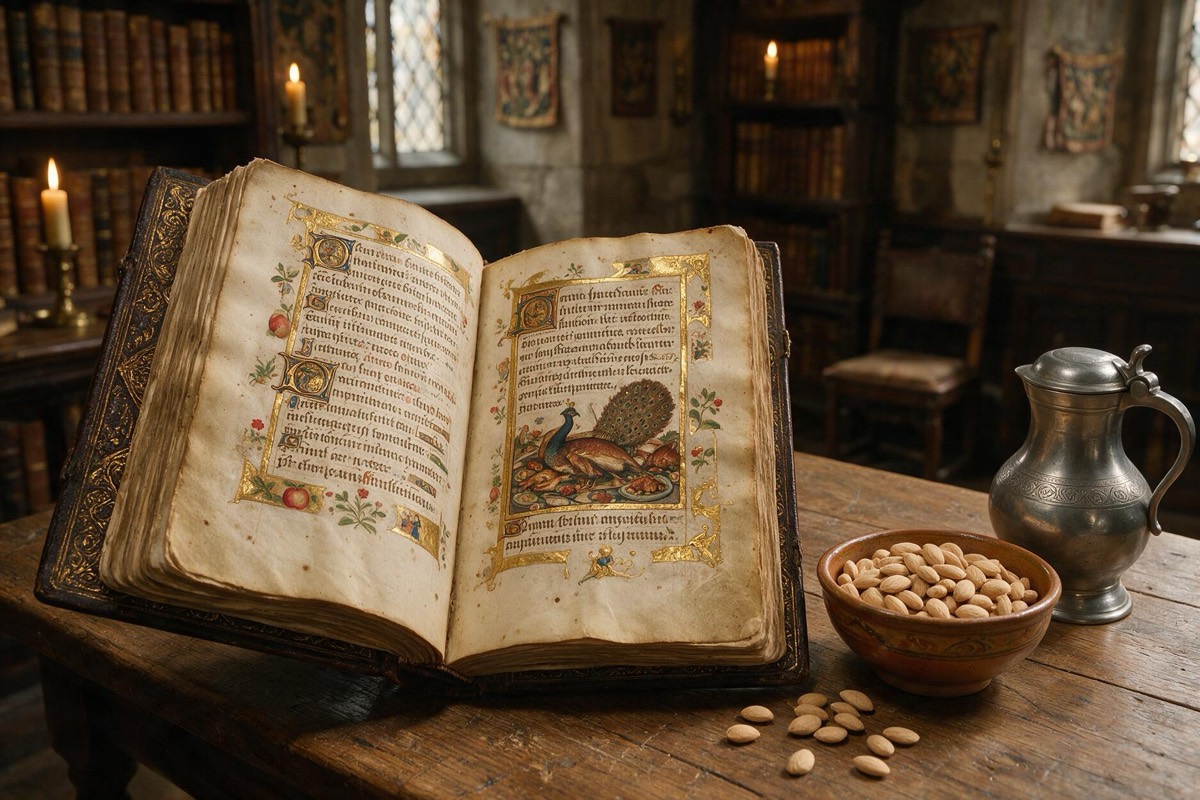
Open almost any surviving medieval cookbook and the same ingredient stares back at you. The Forme of Cury, compiled around 1390 by the master cooks of England's Richard II and surviving as a magnificent six-metre scroll of vellum, is thick with it — the manuscript reaches for almond milk again and again, in dishes for fast days and feast days alike. Cross the Channel and you find the same in Le Ménagier de Paris, the 1393 household manual written by an elderly Parisian for his young wife. Head east and it's there in the German Das Buch von Guter Spise and the Scandinavian Libellus de Arte Coquinaria. Almond milk appears in more medieval recipes than very nearly any other single ingredient — a claim that sounds like hyperbole until you start counting.
It helped that almonds were expensive. Imported, costly and slightly exotic, they turned almond milk into a marker of status as much as a matter of religious convenience: a food of monasteries, royal courts and wealthy households. Edward I of England, records suggest, got through enormous quantities. If you were rich and it was Lent, almond milk was how you ate well while appearing to suffer.
Exit, and a long road back
So what happened? Two things, mostly. Refrigeration, when it eventually arrived, demolished almond milk's killer advantage. Once fresh dairy could be kept from spoiling, the reason to labour over a mortar full of almonds largely evaporated. And the great expansion of cheap, industrial and colonial dairy farming in the eighteenth and nineteenth centuries made cow's milk the unquestioned default. Almond milk didn't vanish, but it dwindled from a kitchen staple to a curiosity — a footnote in old recipe books that historians like Melitta Weiss Adamson would later dust off.
Then it came roaring back. Almond milk is once again in nearly every fridge, though this time the conversation is less about fast days than about the planet, and it's a conversation worth having honestly. Almonds are thirsty: producing a litre of almond milk takes a great deal of water, and around 80 per cent of the world's almonds are grown in drought-prone California, which sparked a wave of "almond-shaming" around 2015. Yet as Food Revolution Network's review of the evidence points out, almond milk still uses far less water and generates fewer emissions than the dairy milk it replaces — a nuance we unpack fully on our environmental impact page and in our piece on plant milk and the planet.
There's a pleasing symmetry to it all. The drink that medieval monks reached for because it wouldn't spoil is now reached for by people trying to spoil the planet a little less. Almond milk was never really new. It's one of the oldest tricks in the European kitchen, dozing for a century or two before its comeback. If you fancy carrying on the eight-hundred-year tradition, our recipes include a version far easier than anything a fourteenth-century cook had to endure, and our dairy-free tips will help you make the switch stick.