Here's the headline, and it's a genuinely good one: switch from cow's milk to almost any plant milk and you shrink the footprint of your daily brew dramatically. That isn't activist wishful thinking. It comes from the single most comprehensive study of food's environmental impact ever assembled.
But "almost any" is doing quiet work in that sentence, and the details underneath are more interesting — and more useful — than the headline alone. So let's do the honest version: the big win, and then the awkward footnotes that a good-faith environmentalist should actually know.
The big number
In 2018, Oxford researcher Joseph Poore and Swiss scientist Thomas Nemecek published a landmark meta-analysis in *Science*, drawing on data from roughly 38,700 farms across 119 countries. It remains the reference point for food life-cycle analysis, and its milk findings are stark.
According to Our World in Data's summary of that dataset, cow's milk "has significantly higher impacts than the plant-based alternatives across all metrics. It causes around three times as much greenhouse gas emissions; uses around ten times as much land; two to twenty times as much freshwater; and creates much higher levels of eutrophication" — the nutrient run-off that chokes rivers and creates ocean dead zones.
Three times the emissions. Ten times the land. Those are not marginal gains. To put a single example in numbers: compared with cow's milk, soya milk uses roughly 2.8% of the water, 7.8% of the land, and produces about 69% fewer greenhouse gas emissions. Whichever plant you pour, you are making a large environmental improvement over dairy, and you can see the full breakdown on our environmental impact page.
Dairy is heavier because cows are inefficient converters. They need vast grazing and feed-growing land, they belch methane — a potent greenhouse gas — and their manure drives eutrophication. A plant is simply a shorter path from field to glass.
The footnotes that matter
If the story ended there it would be a pamphlet, not journalism. Each plant milk carries its own compromise, and pretending otherwise is exactly the greenwashing this section exists to avoid.
Almonds and water. Almond milk has some of the lowest greenhouse emissions and land use of any milk — genuinely impressive. But almonds are thirsty. Producing them takes far more water than soya or oat, and the majority of the world's almonds grow in drought-prone California, where irrigation draws on already-stressed aquifers. Per glass, almond milk can demand dozens of litres of water; Our World in Data notes it "requires more water and results in higher eutrophication" than soya. There is a bee footnote too: California's almond orchards depend on billions of commercially trucked honeybees each spring, a monoculture pressure that has worried pollinator scientists.
Rice and methane. Rice milk is a land-use star — rice needs less growing area than most alternatives. But flooded rice paddies are anaerobic, and that waterlogged soil breeds methane-producing microbes, giving rice milk the highest greenhouse emissions of the common plant milks (still well below dairy). Rice also scores poorly on eutrophication.
Monoculture and the "which crop" question. Any crop grown at global scale — soya especially — raises fair questions about biodiversity and land conversion. The nuance worth holding onto: the overwhelming majority of the world's soya is grown to feed livestock, not to fill oat-milk-style cartons. Drinking soya milk directly is a far shorter, lighter chain than routing that same protein through a cow first.
The myth worth killing: "but it's shipped so far"
A common objection to plant milk is that the ingredients travel — almonds from California, coconuts from the tropics — so surely local dairy wins on "food miles"? The data says no, and it says it emphatically.
Poore and Nemecek found that transport is a tiny slice of most foods' total footprint; the farm stage dominates, and for some products, land-use change. As Our World in Data puts it in its analysis of food choices versus eating local, "what you eat is far more important than where it travelled from." For almost every food, swapping what's in the glass dwarfs any saving from swapping where it came from. A locally milked cow still out-emits an almond that crossed an ocean by cargo ship. So the food-miles worry, while intuitive, points you at the wrong lever.

So which plant milk should you actually pour?
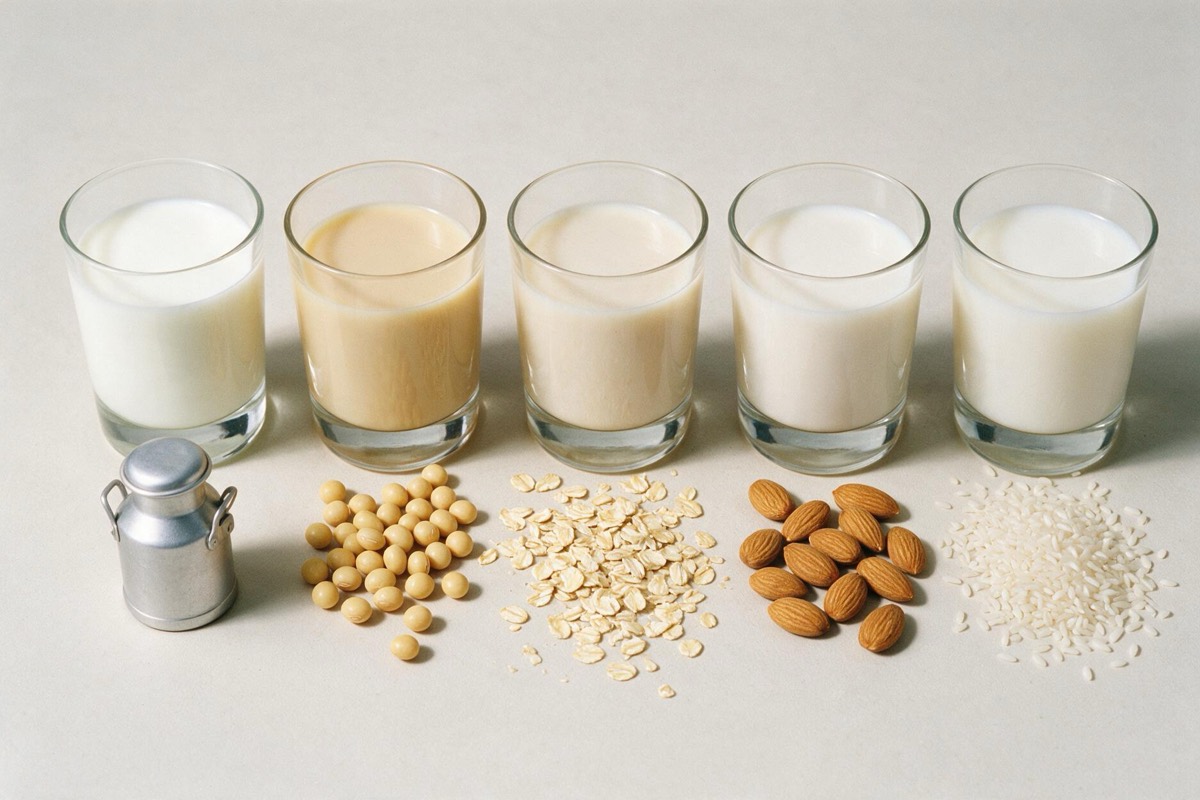
The honest answer is that there's no single winner — and that this is good news, not bad. As Our World in Data concludes, "all of the alternatives have a lower impact than dairy, but there is no clear winner on all metrics." Every plant milk beats the cow; they simply trade strengths.
If you want a rough rule of thumb drawn from the data:
- Oat and soya are the strong all-rounders — low emissions, modest land, modest water, no major red flag. For most people in most places, these are the easy pick.
- Almond is brilliant on carbon and land, but choose it mindful of water — and better still if it isn't from a drought year's California harvest.
- Rice is light on land but heavier on methane and run-off — fine in rotation, not the one to fixate on.
- Coconut is low-impact per litre, though tropical demand raises its own land questions.
The most important comparison, though, isn't between the plant milks. It's between any of them and dairy — and there, the gap is a canyon. Our tips page has practical guidance on choosing, frothing and switching without the faff, and if you fancy testing it in your own kitchen, the 7-Day Challenge is built for exactly that.
The unglamorous conclusion
Environmental writing loves a villain and a hero. The truth about milk is quieter: plant milks are not perfect, they carry real trade-offs, and an honest advocate names them out loud. Almonds drink too much. Rice burps methane. Everything monocultured has questions to answer.
And yet. Line those imperfections up against dairy's three-times emissions and ten-times land use, and they look like rounding errors on a very clear conclusion. You don't need to agonise over finding the optimal plant milk. Switching from cow's milk to any of them is one of the simplest, most effective changes an ordinary person can make to their food footprint — a rare case where the easy choice and the right choice are the same drink. Dig into the full numbers on our impact page, or explore why plant milk was humanity's default for 5,000 years before the cow took over.