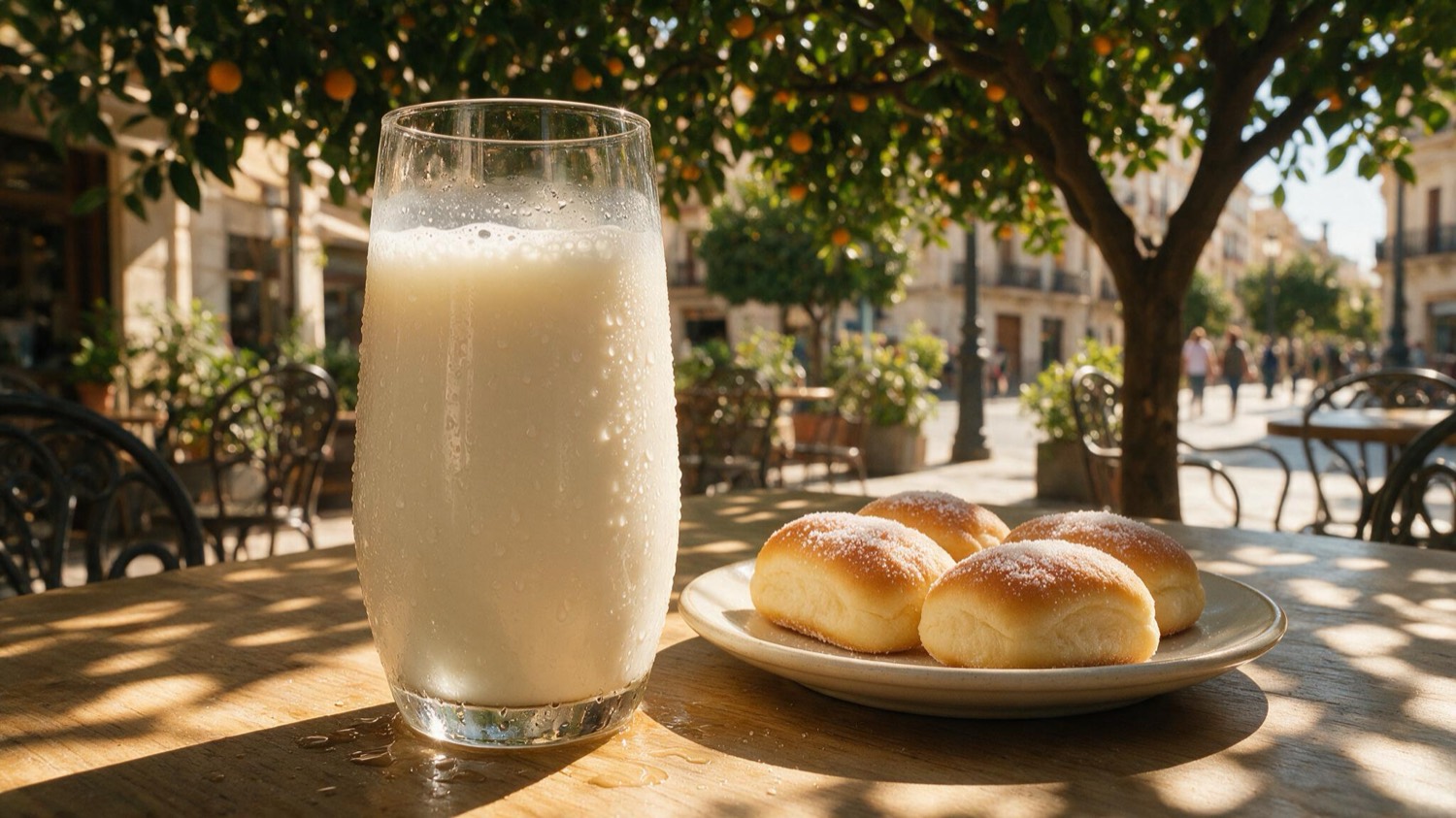
On a blistering July afternoon in Valencia, the most sensible thing you can do is duck into a tiled horchatería, order a glass of something the colour of weak sunshine, and drink it so cold it makes your teeth ache. It tastes of almonds that were never there — nutty, faintly sweet, a little earthy, like a milkshake dreamed up by a field. This is horchata de chufa, and the small wrinkled tuber it's made from has been trailing humans around the Mediterranean for the better part of five thousand years.
Most people assume horchata is a nut milk. It isn't. The chufa, or tiger nut, isn't a nut at all but the tiny underground tuber of a sedge — Cyperus esculentus — a marsh grass in the same botanical family as papyrus, as the Alimentarium food museum is at pains to point out. It earned "tiger nut" from the faint stripes on its shell. Everything else about it is a very long story.
The pharaoh's snack
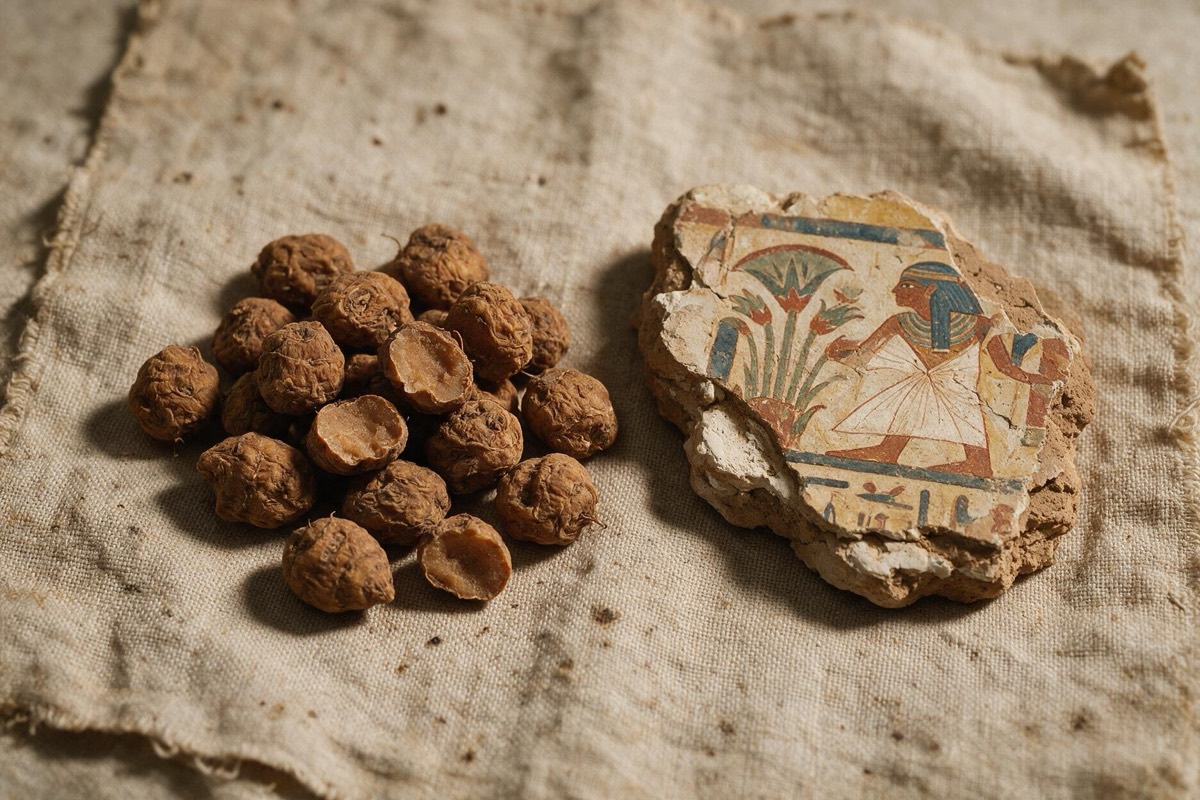
The chufa predates not just Valencia but the very idea of Spain. Archaeologists digging at Wadi Kubbaniya in Upper Egypt have pulled carbonised tiger-nut tubers from the ground and dated them to roughly 16,000 BCE — gathered wild by people living through the last Ice Age, thousands of years before anyone thought to plant a crop on purpose.
By around 5,000 BCE the Egyptians had done exactly that, and the chufa became one of the oldest cultivated foods in the Nile Valley, ranking, by some accounts, just behind emmer wheat and barley. It turns up dried in Predynastic tombs, tucked in alongside the dead for the journey ahead. In the burial chamber of the vizier Rekhmire, painted around 1450 BCE, servants are shown grinding the little tubers with honey and shaping them into ritual cone-cakes — arguably the world's first tiger-nut dessert. A 2021 review paper in an agricultural journal calls the plant, not unreasonably, "a revival of an ancient Egyptian plant." The Egyptians ate them roasted, boiled in beer, and pounded into sweets. What they didn't do, as far as we know, was drink them.
How gold got to Valencia
The chufa travelled the way so many Mediterranean foods did: westward, across North Africa, and into the Iberian Peninsula during the long centuries of Islamic al-Andalus from the eighth century onward. Somewhere along that route, someone worked out that if you soaked the tubers, ground them, and strained the milky liquid, you got a drink. In Valencia — where the sandy, irrigated soil of the coastal plain turned out to suit the fussy little sedge better than almost anywhere on earth — that drink took root and never left. By the thirteenth century, local documents were already referring to llet de xufes, tiger-nut milk, the direct ancestor of the glass in front of you.
And here we arrive at the legend every Valencian will tell you. King Jaume I, the story goes, was handed a cup of the pale drink by a village girl, took one sip, and declared: "Açò no és llet, açò és or, xata!" — "This isn't milk, this is gold, sweetheart!" Hence, supposedly, orxata.
It's a lovely story, and it's almost certainly not true. As the University of Valencia's own science-communication team gently explains, the affectionate word xata isn't documented in Catalan until the nineteenth century, some six hundred years after Jaume I would have said it. The great etymologist Joan Coromines traced orxata instead to the Italian orzata, a barley drink — and a 1734 Spanish dictionary defined horchata as a concoction of melon seeds, pumpkin, almonds and barley water, with no chufa in sight. The truth, in other words, is that horchata is a name that wandered in from elsewhere and settled comfortably onto Valencia's favourite tuber. Which is somehow even more fitting.
The most protected drink in Spain
Today the chufa is treated less like a crop and more like a crown jewel. It grows in just sixteen municipalities of L'Horta Nord, the fertile belt north of Valencia, and the drink carries its own Denominació d'Origen, Xufa de València — the same protected-origin status that guards Rioja wine or Parma ham. Around 5.3 million kilos of dried chufa are harvested each year, roughly 90 per cent of it certified by the regulatory council. Only tubers grown here, in this soil, under these rules, can legally be the real thing.
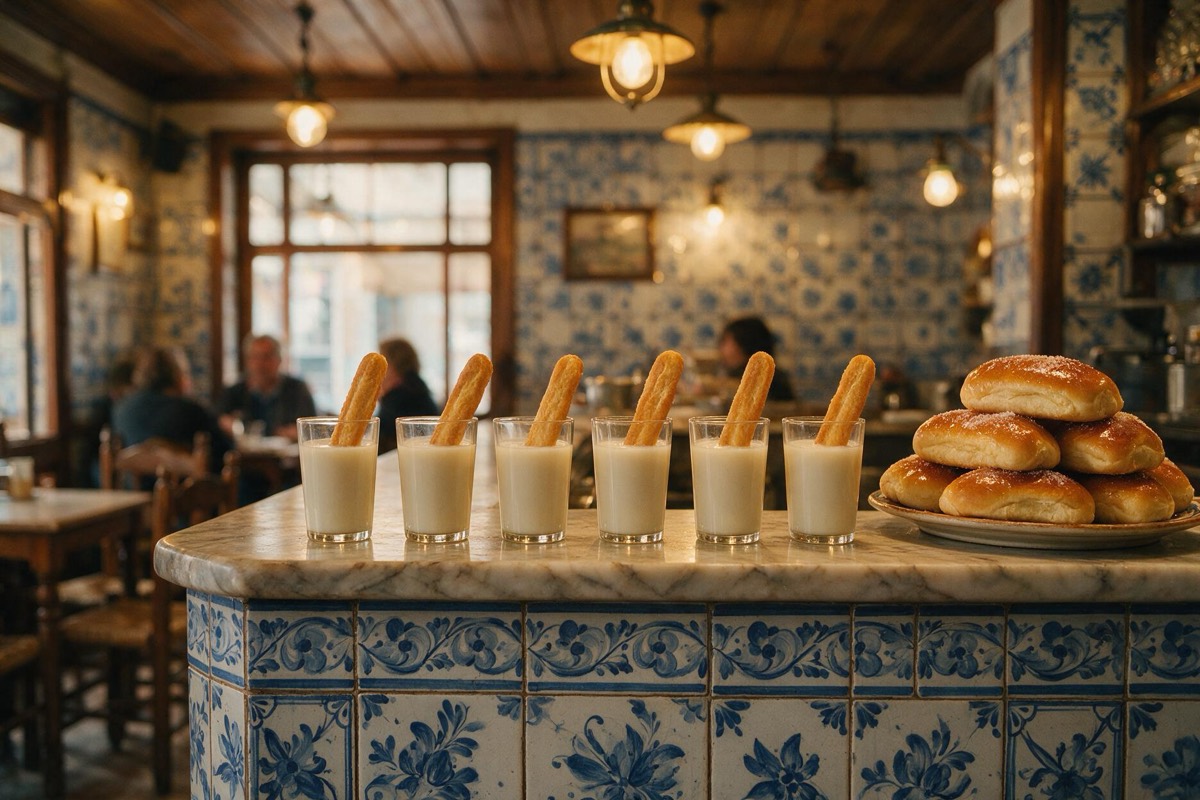
The Valencians take their ritual seriously too. Proper horchata is served ni molt freda ni poc — properly, punishingly cold — ideally alongside fartons, the soft, glossy, finger-shaped buns built for dunking. There's even a footnote of civic pride: the man who first bottled liquid horchata commercially in 1917, Vicente Novejarque, ran a horchatería whose premises would, two years later, host the founding meeting of Valencia Football Club.
A word that crossed an ocean
Here's where it gets confusing for anyone who's only met horchata in a Mexican taquería. That version — creamy, cinnamon-scented, tasting like liquid rice pudding — is a genuine cousin, not an impostor. When the drink crossed the Atlantic with Spanish colonisation, the New World simply had no tiger nuts, so cooks reached for what they did have: rice, sometimes almonds, sweetened and spiced with cinnamon and vanilla. As a comparison of the two traditions notes, the Spanish original came first; the Mexican, Salvadoran and other Latin American horchatas are what happened when a good idea met a different pantry. Same name, same instinct — grind a plant, strain the milk, drink it cold — but two entirely different glasses.
That instinct, of course, is the whole point. Long before "plant milk" was a supermarket aisle, people all over the world were making it from whatever grew nearby — a story you can wander through on the heritage globe. Almonds took a very similar route through medieval kitchens, a tale we tell in the story of medieval almond milk.
So the next time someone tells you plant milk is a modern fad, hand them a glass of horchata. It's been keeping people cool for a thousand years, carries a legend the historians have politely dismantled, and started life as a snack fit for a pharaoh. Not bad for a lump of sedge root. If you'd like to make your own — no tomb-raiding required — our recipes will get you there.