Home → Heritage Hub → Soy Milk
Soy Milk
Explore this story on the interactive globe →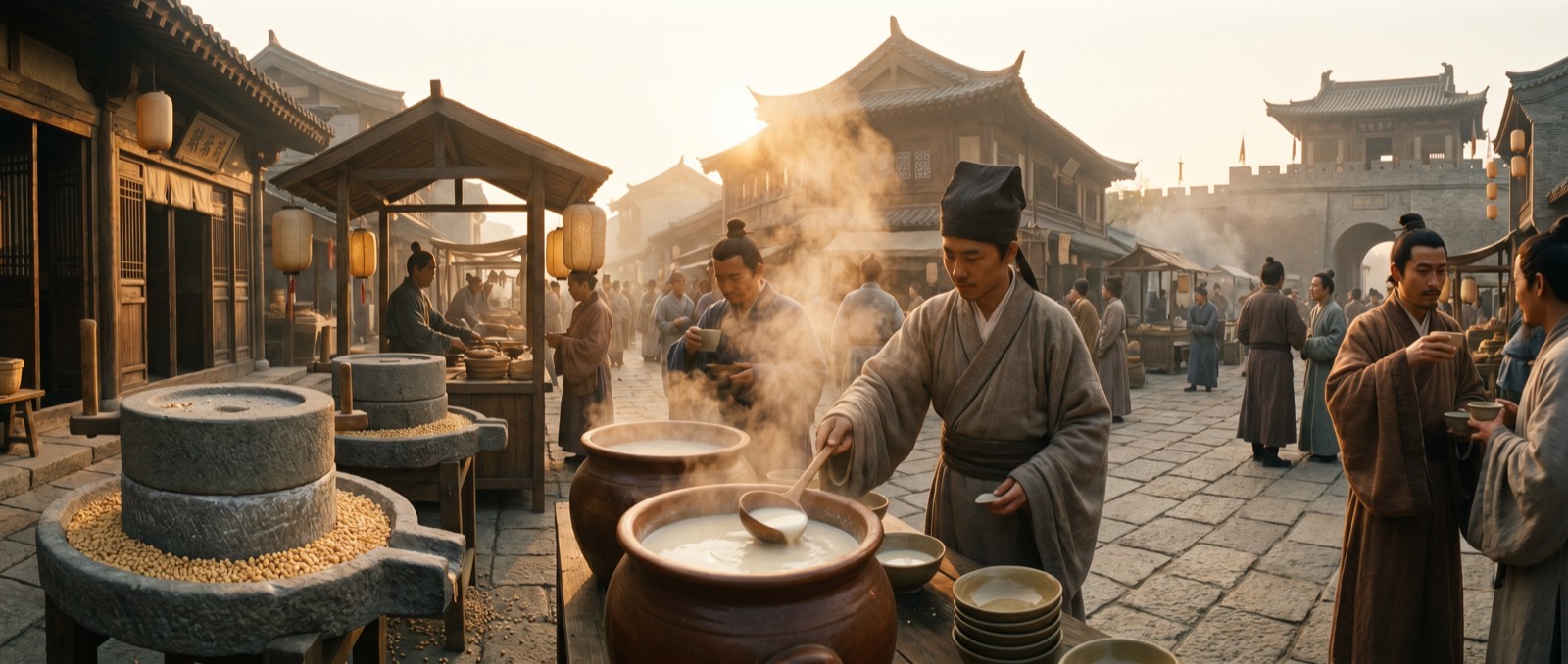
No plant milk has shaped the modern world quite like soy milk. From its first mention in a Chinese text of 82 AD to its role as the catalyst for the entire plant-based dairy industry, soy milk's journey spans two millennia of human innovation—from stone mills in Han Dynasty markets to the gleaming production lines of today's billion-dollar brands.
The Han Dynasty Origins (1st–3rd Century AD)
The earliest known reference to soy milk (doujiang) appears in the Lun Heng, written by Wang Ch'ung in approximately 82 AD. The text mentions that 'makers of doujiang fear that thunder will spoil their product'—an early observation about the sensitivity of soy milk to environmental conditions. Stone carvings from the Han Dynasty (206 BC–220 AD) depict the production process: soybeans being soaked, ground between millstones, and the resulting slurry being strained through cloth. Whether soy milk preceded tofu or vice versa remains debated among food historians, but what is certain is that by the Han period, the Chinese had mastered the art of extracting a nutritious, protein-rich liquid from the humble soybean.
The Dawn Market Tradition
By the Song Dynasty (960–1279 AD), soy milk had become a beloved street food across China. The tradition of the dawn soy milk vendor—rising before sunrise to grind soybeans and prepare fresh, steaming doujiang—became one of the defining rituals of Chinese urban life. Customers would gather at small stalls, dipping long twisted crullers (youtiao) into bowls of hot soy milk. This tradition, documented extensively in Song and Ming Dynasty literature, continues virtually unchanged in Chinese cities today. The drink was served in two forms: savoury (xian doujiang), garnished with pickles, dried shrimp, and spring onions; and sweet (tian doujiang), simply sweetened with sugar.
The Western Discovery
European awareness of soy milk began with Jesuit missionaries in China during the 17th century, but serious Western interest did not develop until the early 20th century. In 1910, Li Yu-ying, a Chinese entrepreneur and biologist, established the first soy milk factory in Paris—the Usine de la Caséo-Sojaïne—producing what he called 'lait de soja.' This pioneering venture, though commercially short-lived, demonstrated that soy milk could be produced at industrial scale. In 1917, the American missionary Harry Miller began producing soy milk in China for infant nutrition, earning him the nickname 'the China Doctor.' His work laid the groundwork for soy milk's eventual global spread.
The Vitasoy Revolution
The modern soy milk industry was born in Hong Kong in 1940, when Kwee-seong Lo launched Vitasoy as an affordable, nutritious alternative to expensive dairy milk. Initially sold warm from pushcarts, Vitasoy struggled until Lo made a crucial innovation in 1953: serving it cold in glass bottles, repositioned as a soft drink rather than a milk substitute. Sales exploded. By the 1970s, the introduction of Tetra Pak packaging allowed soy milk to be stored without refrigeration, enabling its spread across all of Asia. Vitasoy's success inspired dozens of competitors and established soy milk as a mainstream beverage consumed by hundreds of millions daily.
The Global Plant Milk Pioneer
Soy milk's arrival in Western health food stores in the 1970s and 1980s marked the beginning of the entire plant-based dairy movement. Brands like Silk (launched 1996) and Alpro (founded 1980 in Belgium) brought soy milk to mainstream supermarket shelves, paving the way for every plant milk that followed—oat, almond, coconut, and beyond. Though its market share has been overtaken by newer alternatives in some Western markets, soy milk remains the world's most consumed plant milk by volume, with annual global production exceeding 10 billion litres. In East Asia, it is not an 'alternative'—it is simply milk.
Makers of doujiang fear that thunder will spoil their product.Wang Ch'ung, Lun Heng (82 AD)—the earliest known reference to soy milk
Legacy
Soy milk is the ancestor of the modern plant-based dairy revolution. Every carton of oat milk, every almond milk latte, every coconut yoghurt owes a debt to the Chinese innovation of grinding soybeans and straining their milk—a technique perfected two thousand years ago that changed the way humanity thinks about what 'milk' can be.
Key Facts
- Origin
- Eastern China
- First Written Record
- 82 AD (Lun Heng)
- First Western Factory
- Paris, 1910
- Global Production
- 10+ billion litres/year
- Protein Content
- ~3.3g per 100ml
Sources & citations
- History of Soymilk and Dairy-like Soymilk Products — SoyInfo Center (Shurtleff & Aoyagi, unpublished manuscript 'History of Soybeans and Soyfoods'), 2004
- History of Soymilk and Other Non-Dairy Milks (1226-2013) — SoyInfo Center (Shurtleff & Aoyagi), 2013
- History of soy milk — Soya.be, n.d.
- Lunheng (Wang Chong, containing the earliest known reference to doujiang) — Wikipedia, c. 80 AD (text)
- Vitasoy — Wikipedia, n.d.