Home → Heritage Hub → Oat Milk
Oat Milk
Explore this story on the interactive globe →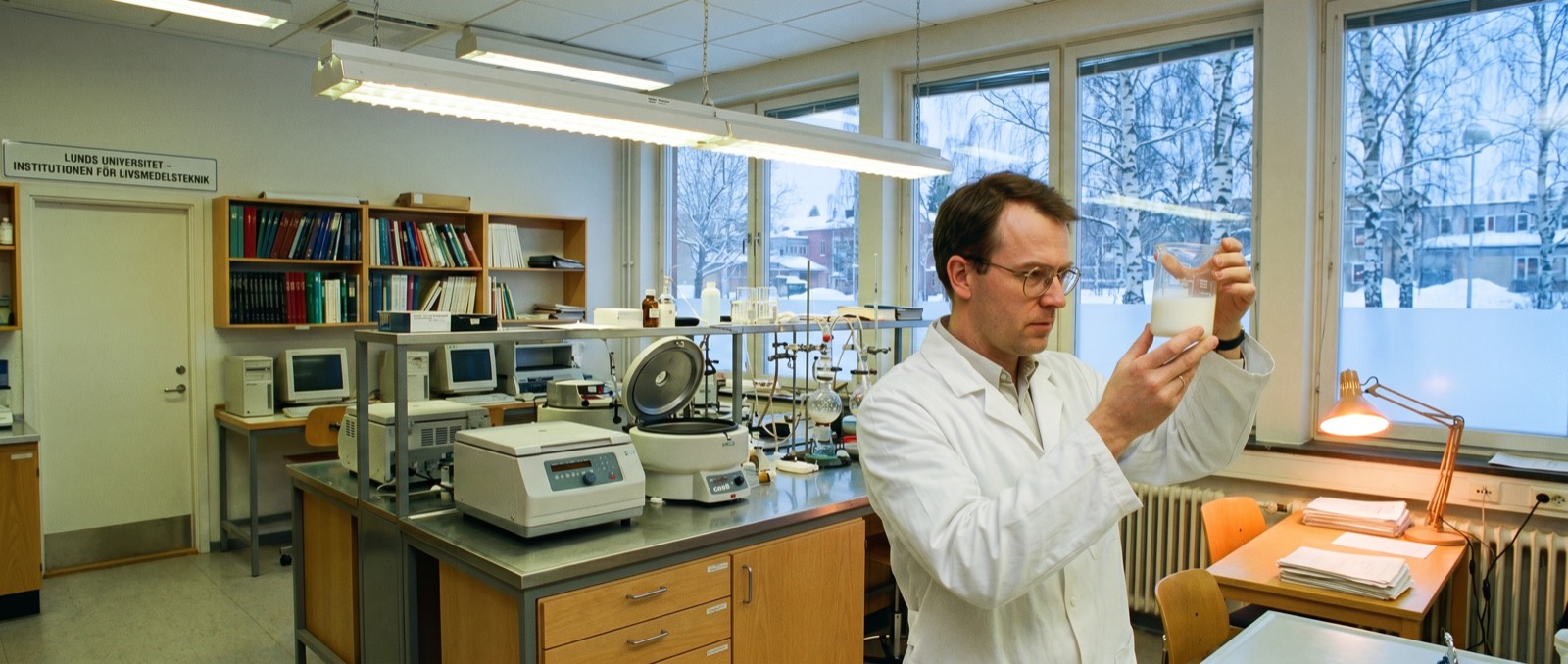
Unlike every other plant milk in this collection, oat milk has no ancient lineage, no archaeological evidence, no centuries of tradition. It was invented in a laboratory in the early 1990s by a single scientist with a simple question: could oats provide a nutritious, sustainable alternative to cow's milk for the lactose intolerant? The answer would transform the entire dairy industry, and add a new chapter to a story begun five thousand years ago by the first humans to press milk from plants.
The Scientist: Rickard Öste
In 1985, Rickard Öste, a food scientist at Lund University in southern Sweden, attended a conference in Japan where he first encountered soy milk. The experience planted a seed: if Asians had created milk from soybeans, could Scandinavians create milk from their own staple grain—oats? Öste was researching lactose intolerance, a condition affecting approximately 65% of the global population, and he recognised that a locally-produced, sustainable plant milk could address both nutritional needs and environmental concerns. Over the next five years, he developed an enzymatic process that broke down oat starch into smaller sugars, creating a naturally sweet, creamy liquid with a mild flavour.
The Founding of Oatly (1994)
In 1994, Öste and his brother Björn founded Ceba AB (later renamed Oatly) to commercialise the invention. The company's patented enzyme technology was the key innovation: by treating oat slurry with specific enzymes, they could break down the beta-glucan fibre and starch into a smooth, drinkable liquid without the grittiness that had plagued earlier attempts at grain-based milks. For nearly two decades, Oatly remained a small, relatively obscure Swedish brand—available in health food stores and hospitals, but unknown to the broader public. The oat milk revolution was still waiting for its moment.
The Barista Revolution (2016–2020)
Oat milk's transformation from niche health product to global phenomenon began in 2016, when Oatly brought its 'Barista Edition'—a formulation specifically designed to froth and steam like dairy milk in espresso drinks. The product was introduced to speciality coffee shops in New York, London, and Berlin, where baristas immediately recognised its superiority over other plant milks for latte art and flavour compatibility. Word raced through the coffee community and beyond. By 2018, Oatly faced chronic shortages as demand outstripped supply. The company's irreverent marketing—'It's like milk, but made for humans'—captured the zeitgeist of a generation increasingly concerned about climate change and animal welfare.
Environmental Impact and the Climate Argument
Oat milk's rise coincided with growing public awareness of dairy farming's environmental footprint. Life cycle analyses consistently show that oat milk produces approximately 80% fewer greenhouse gas emissions than cow's milk, uses 60% less energy, and requires 80% less land. Crucially, oats can be grown in northern climates where almonds (which require water-intensive irrigation in drought-prone California) cannot. This environmental narrative became central to oat milk's identity and appeal—it was a climate action as much as a dairy alternative. By 2024, global oat milk sales exceeded $3.5 billion, with projections suggesting $6.5 billion by 2028.
The Newest Chapter in an Ancient Story
What sets oat milk's rise apart is that it has no tradition to draw upon—no ancient recipe, no cultural heritage, no grandmother's kitchen. It is a product of pure scientific innovation, born in a university laboratory and scaled through modern food technology. Yet in a deeper sense, oat milk is the latest chapter in a story that began 5,000 years ago when the first human ground a plant and extracted its milk. Rickard Öste's invention at Lund University carries forward the same impulse that drove Austronesian seafarers to grate coconuts, Egyptian farmers to grind tiger nuts, and Chinese vendors to mill soybeans at dawn. The tools change; the human ingenuity endures.
Was it possible to create a product that tasted like milk with similar properties, but was made from something else?Rickard Öste, inventor of oat milk, on the question sparked by encountering soy milk in Japan in 1985
Legacy
Oat milk proves that the story of plant-based dairy is not merely historical—it is ongoing. Every generation adds its chapter. The Austronesians gave us coconut milk. The Egyptians gave us tiger nut milk. The Chinese gave us soy milk. The Islamic scholars gave us almond milk. And in 1990, a Swedish scientist in a university laboratory gave us oat milk—the newest link in a chain of human innovation stretching back five millennia. The story is not over. The next plant milk is already being imagined, somewhere in the world, by someone who looks at a humble plant and sees possibility.
Key Facts
- Origin
- Lund University, Sweden
- Invented
- Early 1990s (commercialised 1994)
- Inventor
- Rickard Öste
- Global Sales
- $3.5 billion (2024)
- CO₂ vs Dairy
- ~80% lower emissions
Sources & citations
- How one scientist's drink came to be on the lips of many — Lund University Alumni Network Blog, 2021
- Rickard Öste — Wikipedia, 2025
- Oat milk — Wikipedia, 2025
- How Oatly went from a decades-old obscure brand to a $10 billion IPO — CNBC, 2021