Home → Heritage Hub → Almond Milk in Europe
Almond Milk in Europe
Explore this story on the interactive globe →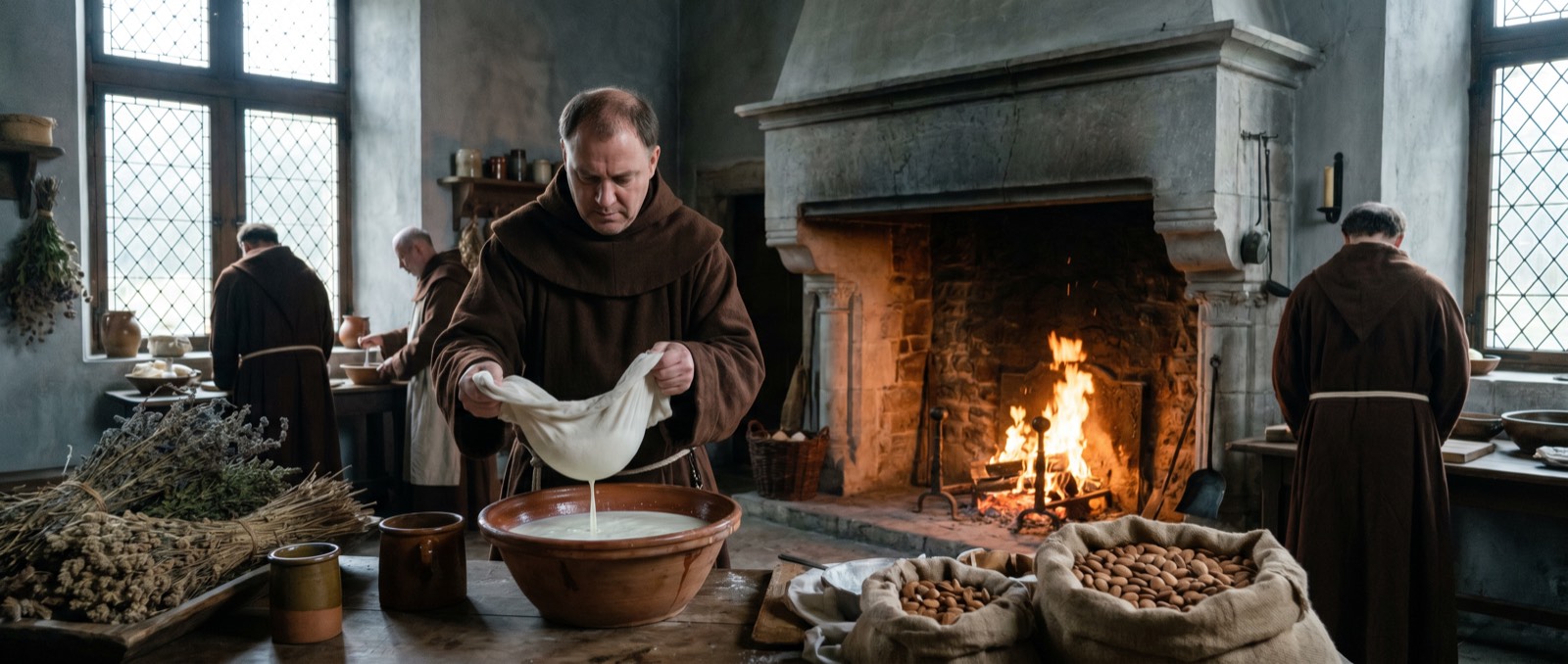
In the cold stone kitchens of medieval monasteries, where monks observed strict fasting rules that prohibited dairy for nearly half the year, almond milk went from substitute to culinary revelation. From Lenten soups to royal banquets, almond milk dominated European cuisine for three centuries—making it arguably the most important cooking ingredient of the Middle Ages.
The Lenten Necessity (13th Century)
Medieval Christian dietary law was extraordinarily restrictive. During Lent (40 days), Advent (4 weeks), every Friday, and numerous saints' days, the faithful were forbidden from consuming meat, eggs, and dairy—amounting to nearly 200 days per year. For the wealthy and for monastic communities, almond milk provided an essential solution. Unlike cow's milk, it did not spoil quickly in an era without refrigeration, and it could be prepared fresh in any quantity. The earliest European almond milk recipes appear around 1300: the French recipe collection 'Le Viandier', attributed to Taillevent, and the English 'Forme of Cury' (1390) both feature almond milk as a foundational ingredient.
The Monastery Kitchen
Benedictine, Cistercian, and Carthusian monasteries became centres of almond milk production and culinary innovation. Monks ground blanched almonds using heavy stone mortars, mixed the paste with warm water, and strained it through linen cloth—a process nearly identical to modern artisanal almond milk production. The resulting liquid was used to make blancmange (literally 'white food'), a dish so ubiquitous in medieval cuisine that it appeared at virtually every noble table across Europe. Monastery records from France, England, and Italy document enormous quantities of almonds purchased specifically for milk production—sometimes hundreds of pounds per month for a single religious house.
Royal Courts and Banquet Culture
Almond milk was not merely a fasting food—it became a marker of wealth and sophistication. At the coronation feast of Henry IV of England in 1399, almond milk featured in multiple courses. Taillevent himself served as master cook at the French court of Charles V. In Italy, almond milk formed the base of sophisticated sauces, soups, and the ancestor of modern marzipan confections. The 15th-century Italian cookbook 'Libro de Arte Coquinaria' by Maestro Martino de' Rossi contains dozens of almond milk recipes, from delicate fish sauces to sweet custards. For three centuries, no European kitchen of any ambition could function without it.
Decline and Renaissance
The Reformation of the 16th century relaxed many fasting rules in Protestant countries, reducing the religious necessity for almond milk. Simultaneously, improved dairy farming and the development of butter-making techniques made cow's milk more available and affordable. By the 17th century, almond milk had largely retreated from everyday European cooking, surviving mainly in confectionery (marzipan, amaretti) and in Mediterranean cuisines where almonds grew abundantly. Its modern renaissance began in the 2000s, driven by veganism, lactose intolerance awareness, and environmental concerns—bringing full circle a tradition that medieval monks would have found entirely familiar.
Take blanched almonds and grind them in a mortar, and draw them up with fair water into a good milk.Forme of Cury, 1390—the oldest known English cookbook
Legacy
Medieval Europe's embrace of almond milk shows what dietary restriction can do for culinary creativity. The monks grinding almonds in their cold stone kitchens weren't simply surviving Lent. They were inventing a cuisine of rare sophistication. Their legacy lives on every time a barista pours almond milk into a latte, unconsciously continuing a tradition born in candlelit cloisters seven centuries ago.
Key Facts
- Origin
- France & England
- Period
- 13th Century onward
- Key Text
- Forme of Cury (1390)
- Primary Use
- Lenten fasting substitute
- Iconic Dish
- Blancmange
Sources & citations
- Medieval Culinary Texts (500-1500) — Martha Carlin, University of Wisconsin-Milwaukee, n.d.
- Almond Milk the Medieval Way — A Dollop of History, 2016
- The Forme of Cury — Wikipedia, c. 1390 (text)
- Le Viandier — Wikipedia, c. 1300 (earliest version)
- Guillaume Tirel (Taillevent) — Wikipedia, 14th century (cook)
- Martino da Como (author of Libro de Arte Coquinaria) — Wikipedia, 15th century (author)