Home → Heritage Hub → Almond Milk
Almond Milk
Explore this story on the interactive globe →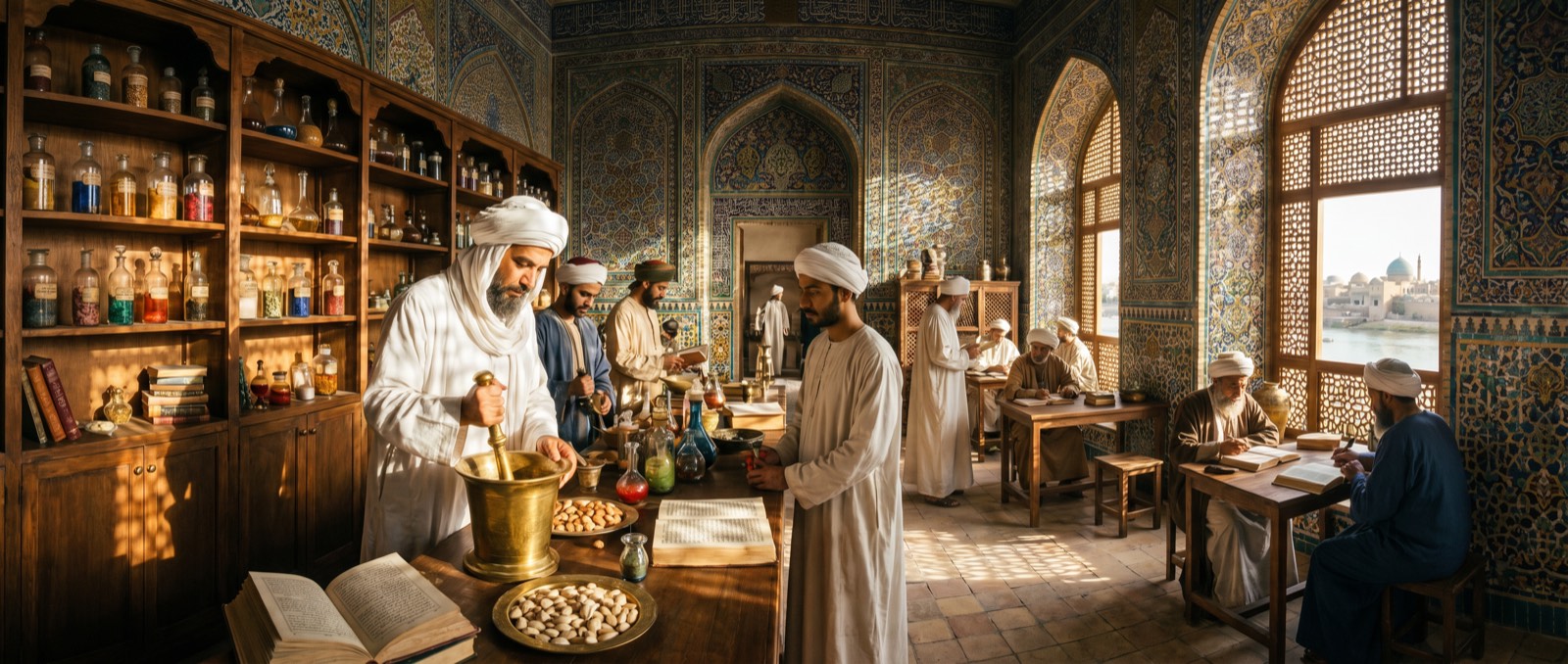
In the great libraries and apothecaries of medieval Baghdad, where scholars were translating Greek philosophy and advancing mathematics, physicians were also documenting a discovery of their own: that the almond, when ground and mixed with water, produced a milk of extraordinary medicinal and culinary value. This is the story of how Islamic civilisation gave the world almond milk.
The Physicians of Baghdad (10th–11th Century)
The earliest documented recipes and uses of almond milk appear in medieval Arabic texts, where physicians of the Islamic Golden Age prescribed it as a remedy for respiratory ailments. The great Persian polymath Ibn Sina (Avicenna, 980–1037 AD) mentioned almond preparations in his Canon of Medicine, among the most influential medical texts in history. His contemporary, the physician Ibn Butlan of Baghdad, included almond milk in his Taqwim al-Sihha (Tables of Health), recommending it for patients with coughs, chest complaints, and digestive disorders. These physicians understood what modern science confirms: almonds are rich in vitamin E, healthy fats, and anti-inflammatory compounds.
From Medicine to Cuisine
By the 10th century, almond milk had transcended its medicinal origins to become a prized culinary ingredient across the Islamic world. The 10th-century Baghdad cookbook Kitab al-Tabikh (The Book of Dishes) by Ibn Sayyar al-Warraq, and al-Baghdadi's 1226 cookbook of the same name, contain numerous recipes calling for 'halib al-lawz' (almond milk), using it as a base for puddings, sauces, and refreshing drinks. The Egyptian cookbook Kanz al-Fawa'id (Treasury of Useful Knowledge, 14th century) features almond milk in both sweet and savoury preparations. In the courts of the Abbasid caliphs, almond milk was flavoured with rose water, saffron, and musk—creating luxurious beverages that symbolised refinement and wealth.
The Transmission to Europe
The Crusades (1096–1291) and the trade networks of the Mediterranean brought almond milk knowledge to Christian Europe. Returning crusaders carried recipes and culinary practices from the Levant. Simultaneously, the Islamic presence in Sicily and the Iberian Peninsula created direct cultural exchange. By the 12th century, almond milk recipes began appearing in European manuscripts—initially in medical texts translated from Arabic, and soon after in cookbooks. What crossed over was more than a recipe. It was a whole culinary idea: that plants could produce a 'milk' equivalent to that of animals.
A Legacy of Innovation
The Islamic world's development of almond milk was more than a culinary achievement. It grew from the intellectual culture of the Golden Age, where observation, experimentation, and documentation transformed traditional knowledge into systematic science. The physicians who first prescribed almond milk were applying the same rigorous methodology they used in astronomy, algebra, and optics. Their careful documentation ensured that this knowledge survived and spread, ultimately reaching every corner of the globe. Today, almond milk is the world's most popular nut milk, with global sales exceeding $5 billion annually—a direct descendant of those first preparations in the apothecaries of Baghdad.
Almond milk soothes the chest, moistens the throat, and brings ease to the breath.After remedies in Ibn Sina's Canon of Medicine, 11th century (paraphrase)
Legacy
The story of almond milk in the Islamic Golden Age is ultimately a story about the power of knowledge transmission. From Baghdad's House of Wisdom to the monastery kitchens of medieval Europe, almond milk travelled along the same routes as algebra, astronomy, and philosophy—carried by scholars, merchants, and pilgrims who understood that nourishment of the body and nourishment of the mind are inseparable pursuits.
Key Facts
- Origin
- Baghdad, Abbasid Caliphate
- Period
- 10th–13th Century AD
- Key Text
- Canon of Medicine (Ibn Sina)
- Arabic Name
- Laban al-lawz
- Modern Market
- $5.2 billion globally (2024)
Sources & citations
- The Historical and Culinary Journey of Almond Milk and Oil in Medieval Arab Cuisine — Middle East Vegan Society, 2024
- Ibn Sayyar al-Warraq — Wikipedia, 10th century (author)
- Kitab al-Tabikh — Wikipedia, 10th century / 1226 (texts)
- The Canon of Medicine (Ibn Sina / Avicenna) — Wikipedia, 1025 (text)
- Tacuinum Sanitatis (Ibn Butlan's Taqwim al-Sihha) — Wikipedia, 11th century (text)