Home → Heritage Hub → Rice Milk
Rice Milk
Explore this story on the interactive globe →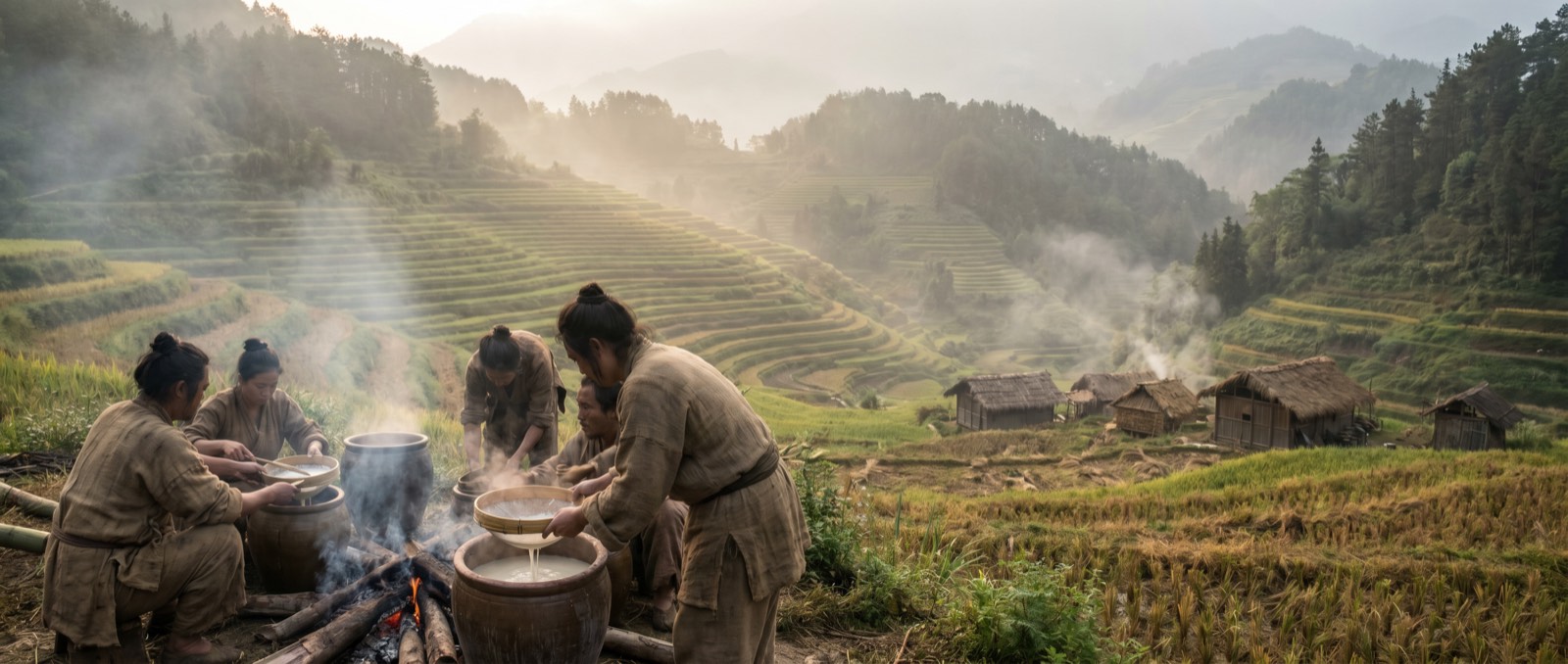
In the mist-shrouded terraces of ancient China, where rice paddies cascaded down the mountainsides in green steps, farmers discovered that their staple grain could yield more than just solid food. By boiling rice until it dissolved into a milky, nourishing liquid, they created one of humanity's earliest and simplest plant-based beverages—a tradition that would evolve into Japan's sacred amazake and Korea's beloved sikhye.
Origins in the Yangtze River Basin (1000 BC)
Rice (Oryza sativa) was first domesticated in the Yangtze River basin around 8000 BC, but evidence suggests that rice-based beverages emerged much later, around 1000 BC, as agricultural techniques became sophisticated enough to produce surplus grain. The earliest rice milks were simple preparations: rice was boiled in excess water until the grains broke down, and the resulting starchy, opaque liquid was strained and consumed as a nutritious drink. This technique required no special equipment—just a pot, water, and rice—making it accessible to even the poorest farming communities.
Amazake: Japan's Sacred Fermented Rice Milk
The most sophisticated evolution of rice milk emerged in Japan during the Kofun period (250–538 AD). Amazake—literally 'sweet sake'—is produced by inoculating cooked rice with koji mould (Aspergillus oryzae), which breaks down the starches into natural sugars over 8–12 hours. The result is a thick, naturally sweet, creamy beverage that the Japanese have revered for over 1,500 years. Amazake is mentioned in the Nihon Shoki (720 AD), Japan's oldest chronicle, and was originally offered to the gods at Shinto shrines. By the Edo period (1603–1868), amazake vendors roamed the streets of Tokyo, selling the warm drink as a restorative tonic—particularly during the hot summer months when its glucose and B-vitamins helped prevent fatigue.
Sikhye: Korea's Festive Rice Punch
In Korea, rice milk took a different evolutionary path. Sikhye is a traditional sweet rice beverage made by steeping cooked rice in barley malt water, allowing the enzymes to convert starches to sugars. Unlike amazake, sikhye is served cold and features whole rice grains floating in the sweet liquid. Its origins are uncertain, but historical records place it in Korean cuisine by at least the Joseon Dynasty (1392–1897). Sikhye is traditionally served at the conclusion of festive meals, particularly during Lunar New Year and Chuseok (harvest festival), and is believed to aid digestion after heavy feasting.
The Modern Rice Milk Revolution
Commercial rice milk as a dairy alternative emerged in the 1980s in the United States, driven by the growing awareness of lactose intolerance and dairy allergies. Unlike traditional Asian rice beverages, modern rice milk uses enzymatic processes to break down the starch into sugars, producing a thin, sweet liquid that mimics the consistency of skimmed cow's milk. Rice Dream, launched in 1990, became one of the first widely available plant milks in Western supermarkets. Today, rice milk remains popular among those with multiple food allergies, as rice is one of the least allergenic foods known.
Amazake is the drink of the gods—sweet without honey, nourishing without meat, warming without fire.Japanese proverb
Legacy
From the terraced paddies of ancient China to the vending machines of modern Tokyo, rice milk in its many forms shows the versatility of humanity's most important grain. The simplest ingredients, worked on by time and culture, can become drinks of real nutritional and spiritual weight.
Key Facts
- Origin
- Yangtze River Basin, China
- First Evidence
- ~1000 BC
- Japanese Form
- Amazake (250–538 AD)
- Korean Form
- Sikhye (Joseon Dynasty)
- Key Property
- Hypoallergenic, naturally sweet
Sources & citations
- History of Amazake and Rice Milk (1000 BCE to 2021) — SoyInfo Center (Shurtleff & Aoyagi), 2021
- A map of rice genome variation reveals the origin of cultivated rice — Nature, 2012
- Amazake — Wikipedia, n.d.
- Sikhye — Wikipedia, n.d.