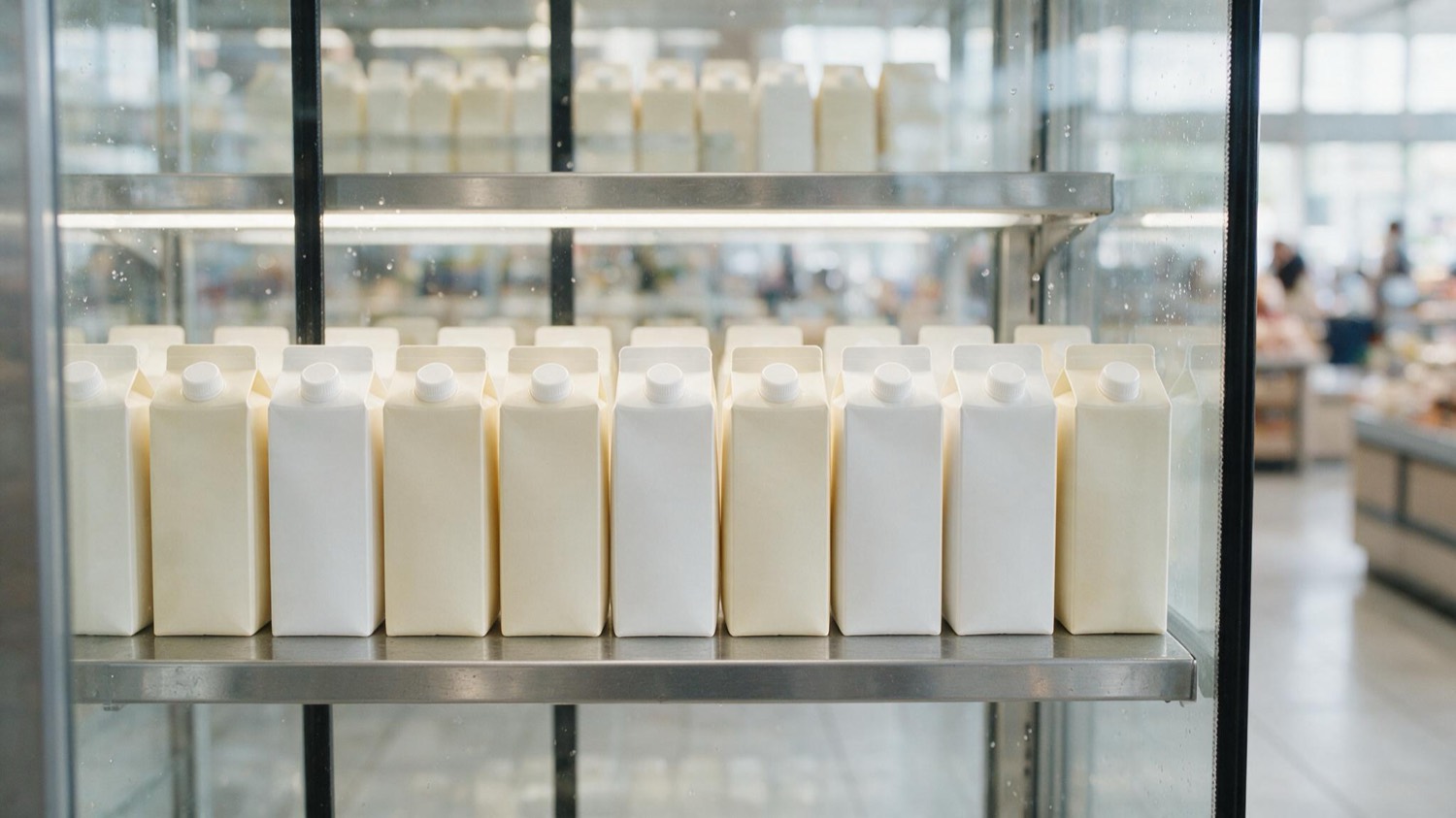
Pick up a carton of oat drink in a British or European supermarket and read the front very carefully. You will almost never see the word you are actually thinking. Not "milk". Instead: "oat drink", "almond drink", "the alternative to milk", or the coy little typographic wink of "m*lk". Somewhere in a marketing meeting, a very tired lawyer insisted on that asterisk.
That asterisk isn't squeamishness. It's the law, and one of the odder corners of European food regulation, because plant milks wore the disputed word comfortably for roughly 800 years before anyone thought to take it away.
The rule that reserves a word
The relevant text is Regulation (EU) No 1308/2013, the sprawling "single market organisation" rulebook for agricultural products. Tucked into Annex VII, Part III, is a definition that leaves no room at all. "Milk", the regulation says, means "exclusively the normal mammary secretion obtained from one or more milkings without either addition thereto or extraction therefrom."
Read that again. To qualify, a liquid must have come out of an animal. And it isn't only "milk" that is fenced off: "cream", "butter", "cheese" and "yoghurt" are reserved too, protected designations that may in principle only be used for products of the udder. There is a short list of allowed animal exceptions and a mechanism for others, but the headline is simple. In the EU, "milk" is a legally protected word, and oats do not have mammary glands.
For years the industry assumed there was wiggle room. Surely, went the thinking, you could say "soya milk" as long as nobody could possibly be confused into thinking a soybean is a cow? A German company called TofuTown decided to find out.
TofuTown goes to Luxembourg
TofuTown sold plant-based products under names like "Soyatoo Tofu Butter", "Plant Cheese" and "Veggie Cheese". A German anti-unfair-competition association took them to court, the case climbed to the Court of Justice of the European Union, and on 14 June 2017 the judges delivered a ruling that has shaped every plant-milk label you have seen since.
The verdict in Verband Sozialer Wettbewerb v TofuTown (C-422/16) was unambiguous. Purely plant-based products cannot be marketed using words like "milk", "cream", "butter", "cheese" or "yoghurt" — and, crucially, not even when the label makes the plant origin perfectly clear. "Soya milk" is out even though no shopper on earth expects a soybean to moo. As the US Library of Congress summarised it, clarifying or descriptive additions make no difference. The court reasoned that consumers might still be misled, and that the protected terms exist precisely so they cannot be diluted.
And so the asterisk was born. "Drink" replaced "milk" across the continent's chillers. The m*lk of the headline isn't a stylistic tic; it's a company trying to say a forbidden word without quite saying it.
The gloriously arbitrary list of exceptions
Here is where the law becomes almost poetic in its inconsistency. Because certain plant "milks" are so deeply embedded in language and tradition that banning them would have been absurd, the EU keeps a formal list of pardoned terms: Commission Decision 2010/791/EU. Its Annex I is a catalogue of words that get to keep "milk", "cream" or "butter" despite containing no dairy at all.
The list is organised by language, which produces wonderfully uneven results. In English, "coconut milk" is fine — you may sell it, cook with it, label it — because its meaning is settled by long custom. "Peanut butter" survives. "Cream of tartar", "cream soda" and "coconut butter" pass. But "almond milk", in English, does not appear on the list. Cross a border and the logic inverts: the French lait d'amande, the Spanish leche de almendras and the Italian latte di mandorla are all specifically permitted, because in those countries almond milk is a culinary heritage worth protecting.
So the same white liquid is legally "milk" in Palermo and legally "drink" in Portsmouth. The regulation isn't describing a substance. It's describing which traditions were powerful enough, in 2010, to earn an exemption.
Meanwhile, in America
Cross the Atlantic and the argument runs the opposite way. US dairy lobbyists spent years pressing the Food and Drug Administration to ban "milk" on plant cartons, citing the "standard of identity" that defines milk as coming from a cow. In February 2023 the FDA finally issued its long-awaited draft guidance — and sided, broadly, with the almonds.
The FDA concluded that consumers already know almond milk isn't cow's milk; the name tells them so. It recommended that plant products may keep the word "milk", provided they add a voluntary nutrient statement where their nutrition differs from dairy — for example, noting lower protein. Same science, same shoppers, opposite conclusion. In Europe the fear is that "milk" misleads; in America the regulator decided the qualifier does the honest work.
The word was ours first
Which brings us to the joke buried under all this litigation. The dairy industry talks as though "milk" has always meant one thing and plant milks are cheeky newcomers borrowing the prestige of the udder. History says almost the exact reverse.
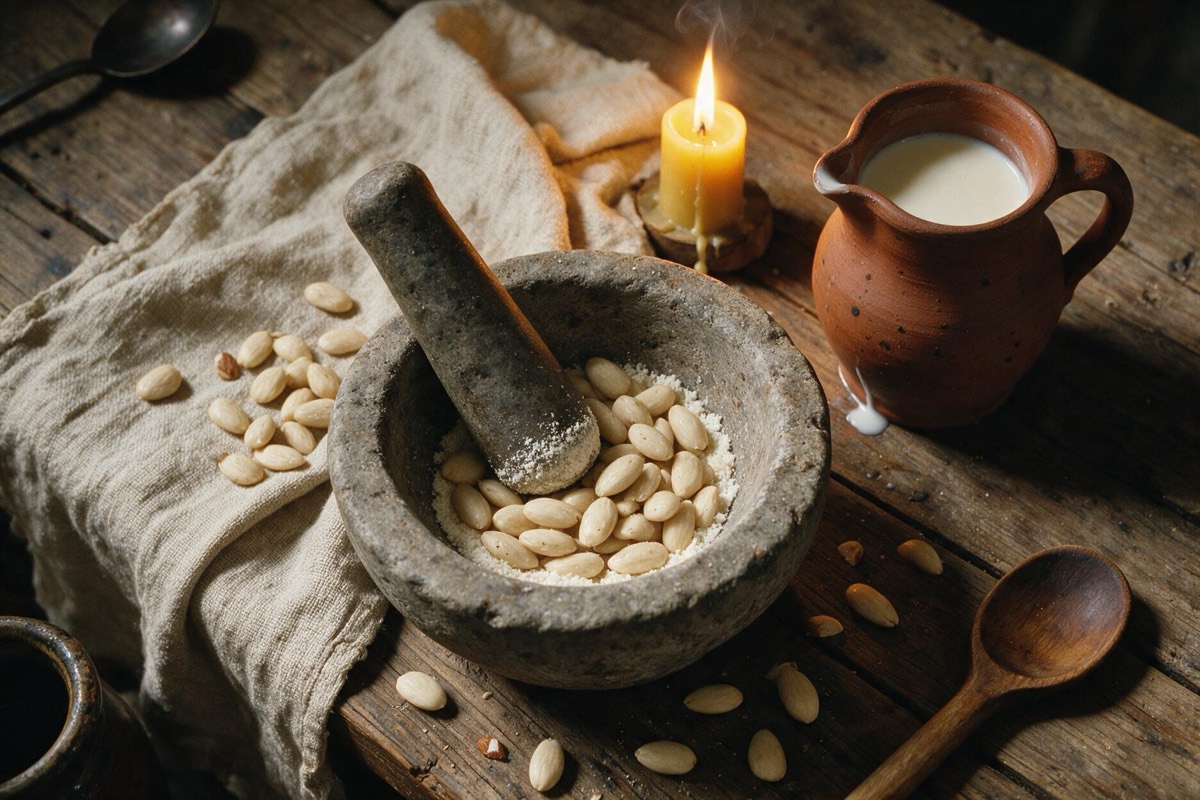
English has used "milk" for the milk-like juices of plants since around the year 1200 — the sense is centuries old, older than most of the cheeses the law now protects. Almond milk in particular was not a fringe product but a medieval superstar. It appears throughout *The Forme of Cury*, the famous cookbook from the court of Richard II, and it was beloved across Christian Europe precisely because it was not dairy: during Lent and the many fasting days when animal milk was forbidden, almond milk kept indefinitely and broke no religious rule. As the Smithsonian notes, nut milks are called "milk" by almost every culture on earth, and have been for a very long time.
Medieval cooks, in other words, would be baffled by the asterisk. To them "almond milk" was not a marketing metaphor borrowed from cows; it was simply a thing you made by grinding almonds with water, and calling it milk was the plainest description available. You can taste that lineage in our own recipes, and trace the full arc of it in plant milk's 5,000-year story and the strange medieval English reign of almond milk.
What the fight is really about
None of this is to say the law is villainous. Protected terms genuinely stop bad actors passing off inferior goods, and shoppers deserve to know what they are buying. But it is worth being honest about what the "milk" rule protects. It's not protecting clarity — no one is fooled — so much as protecting a market, and a particular, recent idea of what a very old word is allowed to mean.
Language isn't owned by regulators or dairy boards. It belongs to the people who use it, and they've been calling plant milks "milk" since before the printing press. The asterisk is a legal artefact, not a linguistic truth. So write it however your local law demands — but know that when you pour a glass of the stuff and call it milk, you're not bending the word. You're using it the way English has, continuously, for the better part of a thousand years. Curious where it all began? Start with the 5,000-year heritage globe — or simply try the 7-Day Challenge and taste the argument for yourself.