Home → Heritage Hub → Peanut Milk
Peanut Milk
Explore this story on the interactive globe →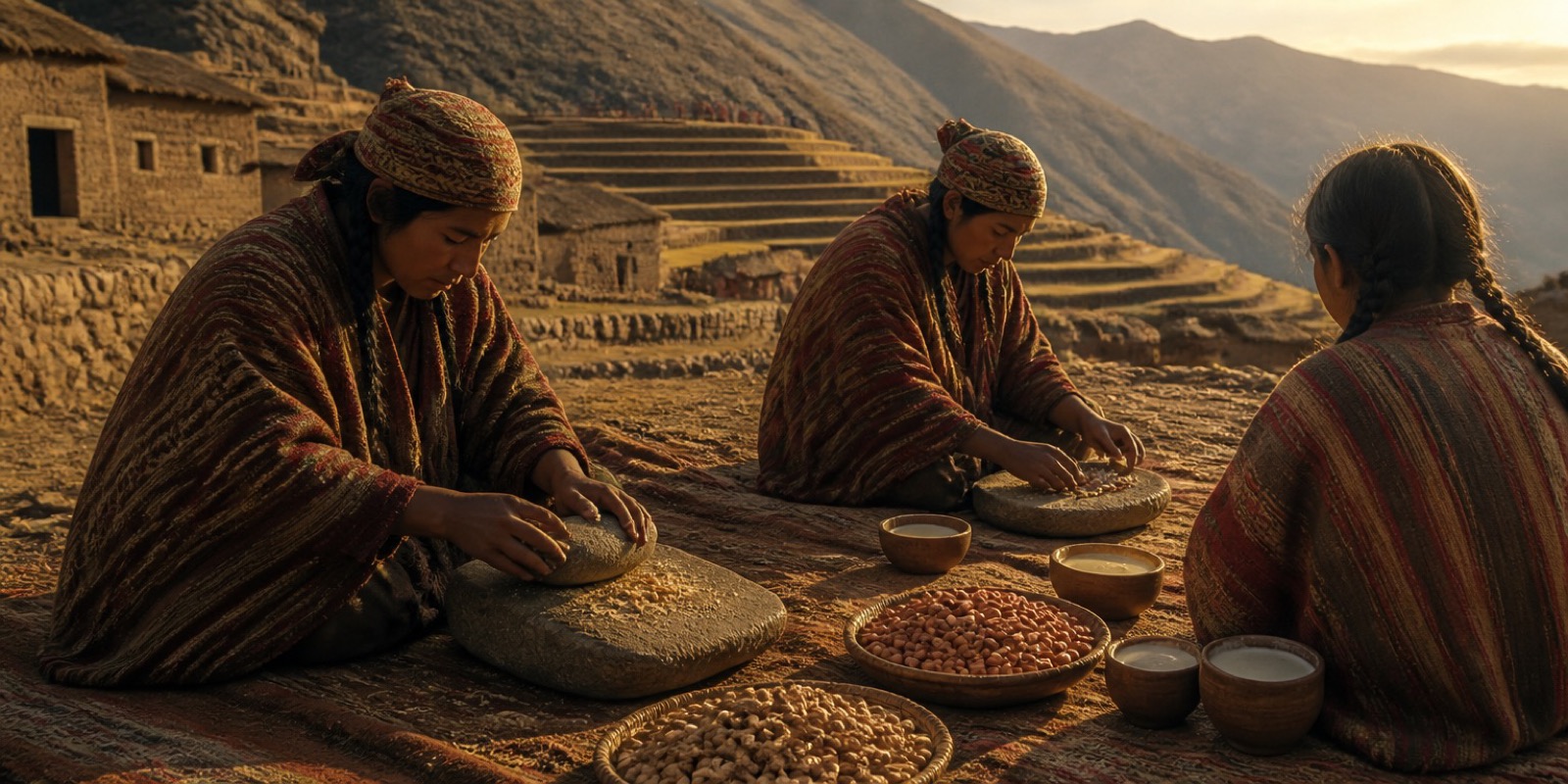
In the dry forest canyons where the Andes fold down towards Peru's northern coast, farmers were tending peanut plants while the pyramids of Egypt were still unimagined. The peanut is so thoroughly woven into African and Asian cooking that its true birthplace often comes as a surprise: this is a South American plant, domesticated in the shadow of the Andes, and its story as a milky, nourishing drink begins there too.
Roots in the Ñanchoc Valley (approximately 5600 BC)
The peanut, Arachis hypogaea, is a natural hybrid of two wild species from the region where modern Bolivia, Paraguay and northern Argentina meet — the eastern foothills of the Andes and the fringes of the upper Amazon. The strongest archaeological evidence of its early adoption, however, comes from further north. Excavating preceramic sites in Peru's Ñanchoc Valley, a team led by Professor Tom Dillehay of Vanderbilt University recovered peanut hulls from house floors and hearths directly radiocarbon-dated to approximately 7,600 years ago, published in Science in 2007. Because the plants did not grow wild in that area, the team concluded they had been domesticated elsewhere and carried in by traders or mobile horticulturists — evidence of farming, irrigation and settled village life in the Americas far earlier than once believed. The peanut was already a travelling crop, millennia before it crossed an ocean.
Gold and Silver Peanuts: The Moche and the Inca (approximately AD 100–1500)
No civilisation honoured the peanut quite like the Moche of Peru's north coast. When archaeologists opened the unlooted tomb of the Lord of Sipán at Huaca Rajada in 1987, they found the warrior-priest wearing a necklace of large peanut-shaped beads — ten worked in gold on his right side, ten in silver on his left, a pairing generally read as sun and moon, masculine and feminine, held in balance. Peanuts, which grow underground, are thought to have symbolised the earth to which the dead return. Moche potters also modelled the humble pod in ceramic. Centuries later, the Inca placed peanuts in tombs as provisions for the afterlife and used them in offerings, while across the continent indigenous peoples ground peanuts with maize into thick, sustaining beverages — the peanut's first life as a drink.
Leche de Maní: A Living Tradition
In the Andes, the peanut never stopped being drunk. Across Bolivia, Ecuador and Peru, leche de maní — peanut milk — remains an everyday comfort: raw or toasted peanuts soaked, ground and simmered with water, cinnamon, cloves and sugar into a warming, creamy drink, often ladled out steaming at market breakfast stalls in the cool of the highland mornings. Bolivia's eastern lowlands prepare chicha de maní, a refreshing cold cousin blended from ground peanuts, rice and unrefined cane sugar, while sopa de maní, the beloved peanut soup, holds a claim to being the national dish. These are not modern inventions imitating dairy but continuations of an unbroken American tradition of turning ground peanuts into nourishing liquid food — one that predates the arrival of European cattle on the continent entirely.
From the Andes to the World (16th century onwards)
The peanut's global journey began soon after 1500, when Portuguese traders encountered it in Brazil and carried it to their enclaves on the West African coast; the Spanish, meanwhile, shipped it westward across the Pacific to the Philippines and onward into Asia. In West Africa the newcomer found a landscape already prepared for it: farmers there had long cultivated the indigenous Bambara groundnut and pounded it into milky drinks such as kunun gyada — the tradition told in our West African groundnut milk story. The American peanut, higher-yielding and oil-rich, was adopted into those same fields and recipes, so completely that many later assumed it was African-born. It was from Africa, in turn, that the peanut reached North America. The plant the world calls a groundnut had already been South America's for seven millennia.
We believe the development of agriculture by the Ñanchoc people served as a catalyst for cultural and social changes that eventually led to intensified agriculture, institutionalized political power and new towns in the Andean highlands and along the coast 4,000 to 5,500 years ago.Professor Tom Dillehay, Vanderbilt University, announcing the Ñanchoc Valley findings (2007)
Legacy
Every glass of peanut milk poured today — in a Bolivian market, a Lagos kitchen or a London café — descends from an Andean and Amazonian story more than seven millennia deep. The peanut fed farmers before the pyramids, adorned the Lord of Sipán in gold and silver, and crossed the world in the holds of colonial ships. Leche de maní endures as living proof: the world's favourite groundnut is, first and forever, South American.
Key Facts
- Origin
- Andean foothills & upper Amazon, South America
- First Evidence
- ~7,600 years ago
- Botanical Name
- Arachis hypogaea
- Living Tradition
- Leche de maní (Andes)
- Key Nutrients
- Plant protein, niacin, vitamin E, magnesium
Sources & citations
- Earliest-known evidence of peanut, cotton and squash farming found (Dillehay et al., 'Preceramic Adoption of Peanut, Squash, and Cotton in Northern Peru', Science 316) — Vanderbilt University News, 2007
- The genome sequences of Arachis duranensis and Arachis ipaensis, the diploid ancestors of cultivated peanut — Nature Genetics, 2016
- Lord of Sipán — Wikipedia, 2025
- Peanut — Wikipedia, 2025