Home → Heritage Hub → Groundnut Milk
Groundnut Milk
Explore this story on the interactive globe →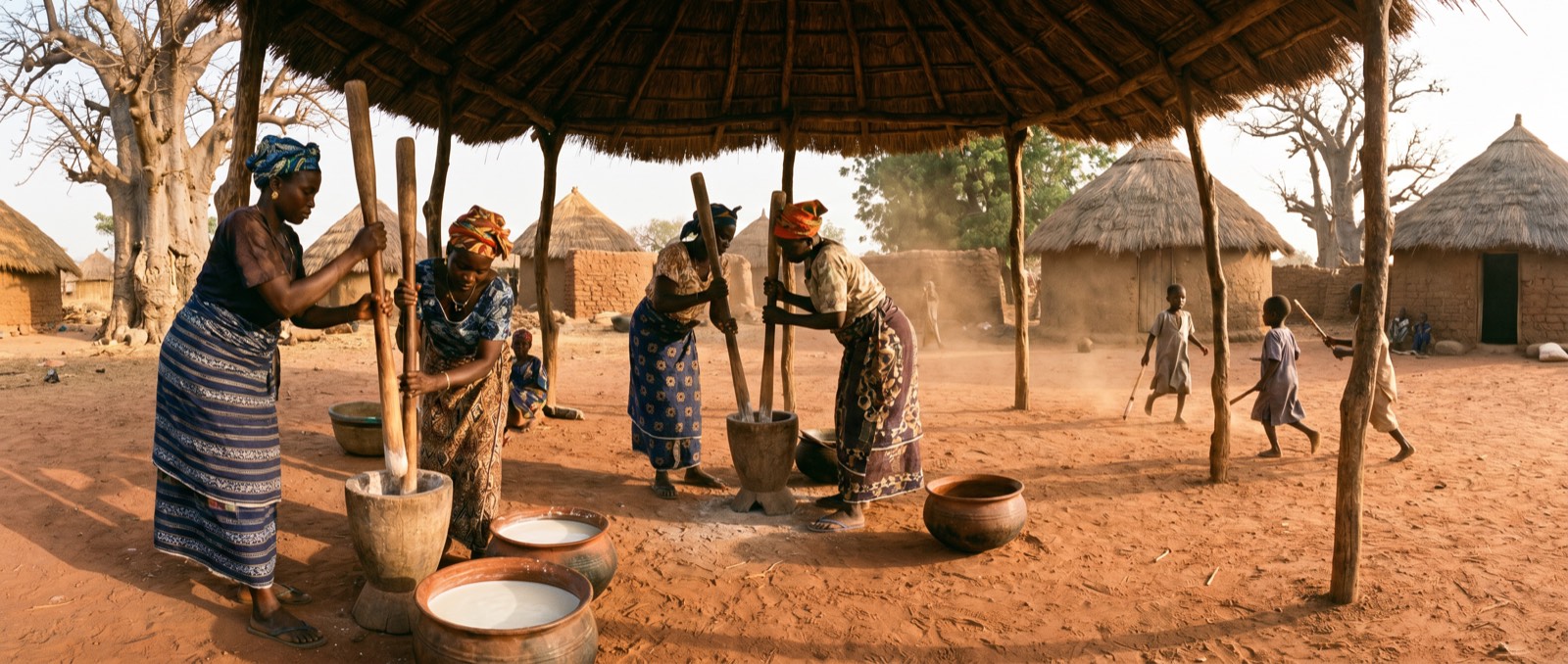
Beneath the baobab trees of West Africa, in villages where the red laterite earth meets the golden savannah, women have pounded groundnuts into nourishing milk for countless generations. This is the story of kunun gyada—groundnut milk—one of Africa's most enduring and nutritionally complete plant-based beverages, and a tradition carried down the generations in oral rather than written history.
The Bambara Groundnut: Africa's Complete Food
The Bambara groundnut (Vigna subterranea), indigenous to West Africa, has been cultivated for at least 2,000 years. Unlike the peanut (Arachis hypogaea), which originated in South America, the Bambara groundnut is truly African—domesticated in the region between modern-day Mali and Nigeria. It is often called a 'complete food' because it contains significant protein (18–24%), carbohydrates, and fat in balanced proportions. Archaeobotanical finds are rare, but remains dated to roughly 2,000 years ago confirm its long cultivation, though the precise origins of groundnut milk preparation are preserved in oral rather than written history.
Kunun Gyada: The Hausa Tradition
In the Hausa-speaking regions of Northern Nigeria, Niger, and Cameroon, kunun gyada (groundnut milk porridge) is a beloved traditional beverage that has sustained communities for generations. The preparation — today usually made with peanuts, adopted after their 16th-century arrival from South America — is simple and ingenious: raw groundnuts are soaked, ground in a wooden mortar with a pestle, mixed with water, and strained through a fine cloth. The resulting milk is often combined with rice flour or millet to create a light, nutritious porridge. Served at room temperature or slightly warm, kunun gyada is a common breakfast food, a weaning food for infants, and a refreshing drink offered to guests as a sign of hospitality.
Women's Knowledge, Women's Labour
Across West Africa, the preparation of groundnut milk is predominantly women's work—and women's knowledge. The techniques of soaking, grinding, straining, and flavouring are passed from mother to daughter, grandmother to granddaughter, in an unbroken chain of oral tradition. In many communities, the ability to prepare excellent groundnut milk is a mark of domestic skill and cultural knowledge. Women's cooperative groups often produce groundnut milk for sale at local markets, providing essential income for families. This gendered dimension of plant milk production—rarely acknowledged in Western narratives of plant-based dairy—is one of the world's oldest food-production traditions led entirely by women.
Nutritional Security and Modern Potential
In regions where cow's milk is expensive, unavailable, or culturally inappropriate, groundnut milk provides essential nutrition—particularly for children. Studies by the International Institute of Tropical Agriculture (IITA) have demonstrated that groundnut milk can match or exceed cow's milk in protein content while providing essential fatty acids and minerals. In the context of climate change, the Bambara groundnut's drought resistance and nitrogen-fixing properties make it a crop with rare potential for food security. Modern food scientists are now studying traditional African groundnut milk preparations as models for sustainable nutrition—recognising that indigenous knowledge systems may hold solutions to 21st-century challenges.
The groundnut feeds the family when the rains fail and the cattle grow thin.West African proverb
Legacy
Africa's groundnut milk tradition challenges the dominant narrative that plant-based dairy is a modern Western invention. For millennia, African women have produced nutritionally complete plant milks using indigenous crops and traditional techniques—a heritage of innovation that deserves recognition alongside the more documented histories of Asian and European plant milks. As the world searches for sustainable protein sources, Africa's groundnut tradition may have been ahead of us all along.
Key Facts
- Origin
- West Africa (Ghana, Mali, Nigeria)
- Crop Age
- 2,000+ years cultivated
- Key Preparation
- Kunun Gyada
- Protein Content
- 18–24% (Bambara groundnut)
- Climate Advantage
- Drought-resistant, nitrogen-fixing
Sources & citations
- Lost Crops of Africa: Volume II: Vegetables — Chapter 3: Bambara Bean — National Academies Press, 2006
- Bambara Groundnut: An Underutilized Leguminous Crop for Global Food Security and Nutrition — Frontiers in Nutrition, 2020
- Vigna subterranea — Wikipedia, 2025
- Kunun Gyada (Groundnut Milk and Rice Gruel) — All Nigerian Recipes, 2023
- The invention of agriculture in Africa — African History Extra (Isaac Samuel), 2023