Home → Heritage Hub → Macadamia Nut
Macadamia Nut
Explore this story on the interactive globe →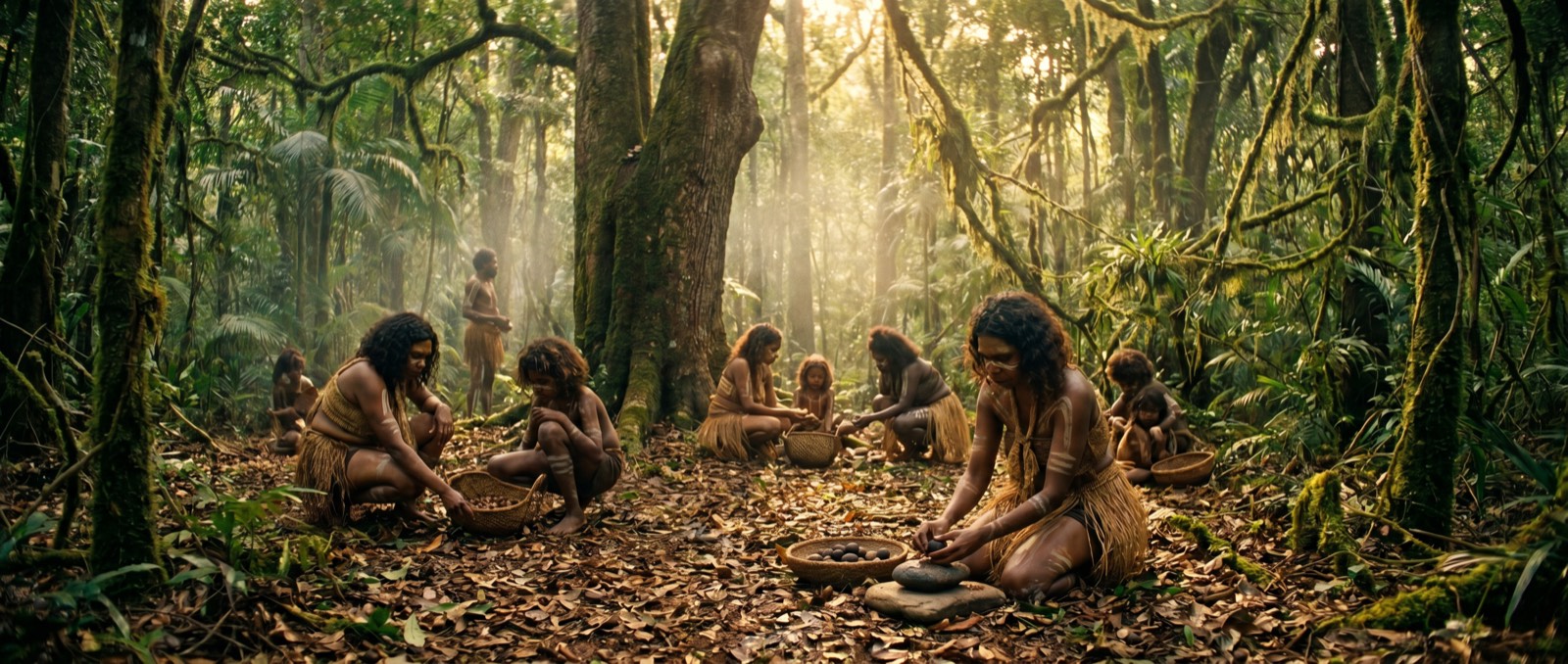
In the subtropical rainforests of what is now Queensland, Australia, Aboriginal peoples have gathered, processed, and traded macadamia nuts for over 40,000 years—making it one of the oldest continuous food traditions on Earth. Known as kindal-kindal, boombera, and by dozens of other names across language groups, the macadamia is Australia's most significant contribution to global food culture, and its story upends the usual timeline of 'nut milks.'
40,000 Years of Indigenous Knowledge
The macadamia tree (Macadamia integrifolia and M. tetraphylla) evolved in the rainforests of eastern Australia millions of years ago. Aboriginal peoples of the Bundjalung, Yugambeh, Turrbul, and Jagera nations—among many others—developed sophisticated knowledge systems around the macadamia over tens of thousands of years. They identified the best-producing trees, understood seasonal fruiting patterns, and developed techniques for cracking the extraordinarily hard shells using carefully selected flat stones. Archaeological evidence from the Bauple Mountains in Queensland shows macadamia processing sites dating back at least 5,000 years, though oral traditions suggest use extending far deeper into the past.
Bunya Festivals and Trade Networks
The macadamia was a trade commodity as much as a local food, connecting Aboriginal nations across vast distances. During the great Bunya festivals, when thousands of people gathered from across eastern Australia, macadamia nuts were among the prized foods exchanged between groups. Aboriginal peoples also planted macadamia trees along travelling routes—a form of landscape management that created 'corridors' of food resources across the country. This practice, sometimes called 'firestick farming' in its broader context, is one of humanity's earliest forms of deliberate food cultivation—predating Middle Eastern agriculture by tens of thousands of years.
Colonial Appropriation
When European botanist Ferdinand von Mueller formally described the macadamia in 1857, naming it after his colleague John Macadam, the tree had already been sustaining Aboriginal communities for millennia. The colonial period saw systematic dispossession of Aboriginal peoples from their traditional lands—including the rainforests where macadamias grew. By the early 20th century, commercial macadamia orchards were being established in Queensland and later Hawaii, with virtually no acknowledgment of Aboriginal knowledge or rights. It was not until the late 20th century that the depth of Aboriginal macadamia knowledge began to be recognised by non-Indigenous Australians.
The Modern Macadamia Milk Movement
Macadamia milk entered the commercial plant milk market in the 2010s, positioned as a premium, creamy alternative with a buttery flavour profile. Brands like Milkadamia (founded 2015) and others have built global businesses on the macadamia's unique properties: its high fat content (75% monounsaturated) creates an exceptionally creamy milk that froths well for coffee. The Australian macadamia industry is now worth over $1 billion annually. Yet as this industry grows, there is increasing recognition that Aboriginal peoples—the original custodians of macadamia knowledge—must be centred in its story and share in its economic benefits.
Towards Recognition and Reconciliation
In recent years, initiatives like the Australian Macadamia Society's acknowledgment of Aboriginal heritage, and Indigenous-owned macadamia enterprises, represent steps toward recognising the true origins of this food. The story of the macadamia is ultimately a story about whose knowledge counts, whose history is told, and who benefits from the fruits of the land. As the world embraces macadamia milk as a 'new' plant-based innovation, it is essential to remember that Aboriginal Australians were the first plant milk innovators—not decades or centuries ago, but tens of thousands of years before any other culture on Earth.
We have always known these trees. They are our ancestors' gift, planted along the paths so that those who walk after would never go hungry.Adapted from Aboriginal oral tradition
Legacy
The macadamia's story makes one thing plain: innovation did not begin with laboratories and startups. For over 40,000 years, Aboriginal Australians developed, maintained, and transmitted knowledge of this extraordinary nut—knowledge that the modern world is only now beginning to appreciate. Every macadamia milk latte is, whether we acknowledge it or not, built upon the foundation of the world's oldest continuous food culture.
Key Facts
- Origin
- Queensland, Australia
- Indigenous Use
- 40,000+ years
- Aboriginal Names
- Kindal-kindal, Boombera
- Fat Content
- 75% monounsaturated
- Industry Value
- $1+ billion (Australia)
Sources & citations
- History — Wild Macadamia Conservation, 2024
- Australian macadamias: history in a nutshell — Australian Geographic, 2017
- Guide to the Macadamia in Aboriginal Cultures — Discover Aboriginal Experiences (Tourism Australia), 2023
- Macadamia — Wikipedia, 2025