Home → Heritage Hub → Brazil Nut Milk
Brazil Nut Milk
Explore this story on the interactive globe →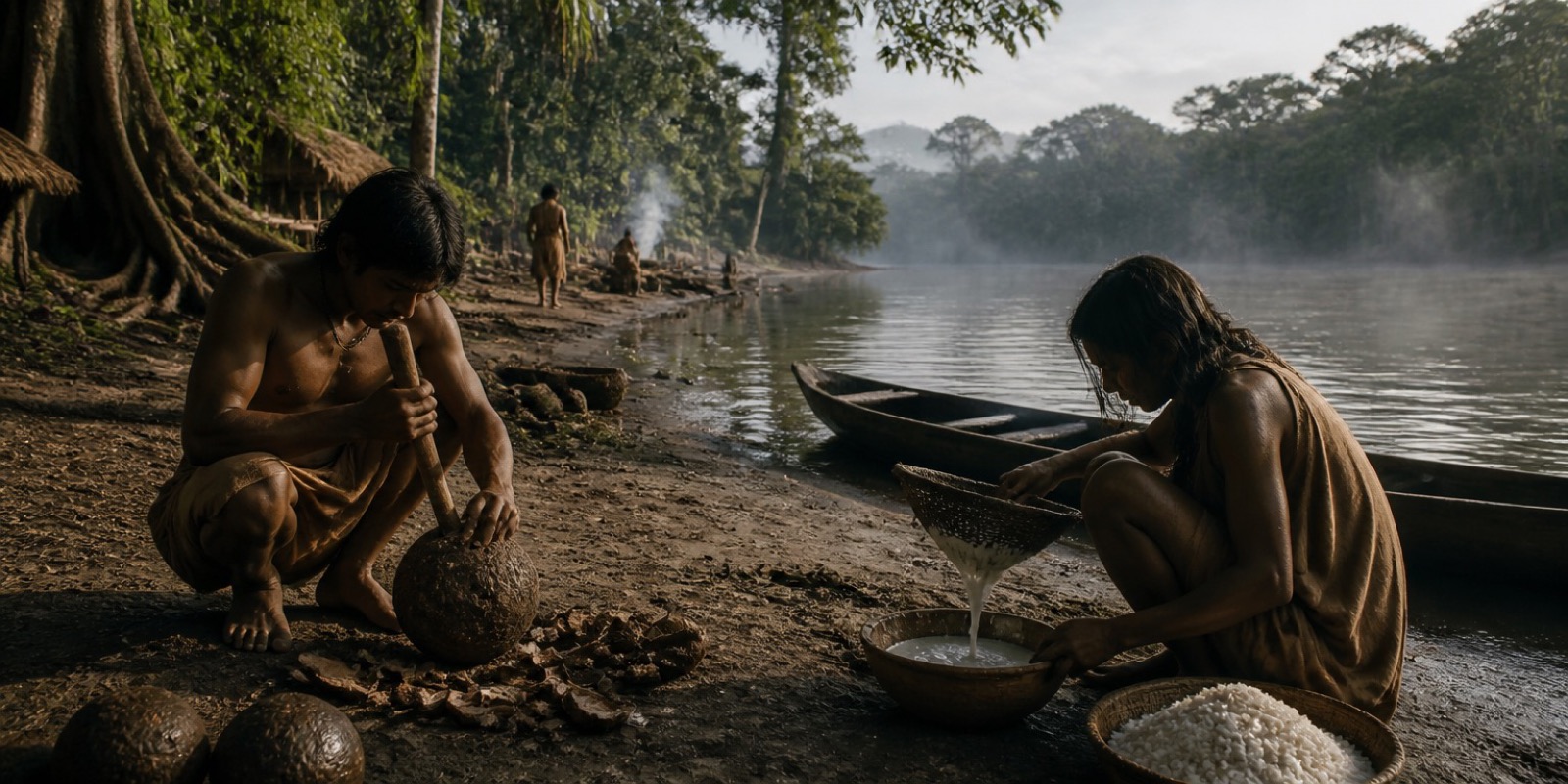
Deep in the Amazon, in the wet months from December to March, a sound like distant gunfire echoes through the canopy: woody fruit capsules the size of grapefruits, weighing up to two kilograms, falling fifty metres from the crowns of Bertholletia excelsa. Gatherers wait for the thudding to stop before venturing beneath the trees. Inside each capsule lie the seeds that Amazonian peoples have, for centuries, transformed into a rich, ivory-coloured milk.
A Giant Bound to the Forest
The Brazil nut tree is among the largest and longest-lived organisms in Amazonia, rising some fifty metres above the forest floor and surviving, by many estimates, for several centuries. Its reproduction depends on an intricate web of partnerships. The cream-coloured flowers are hooded and tightly sprung; only large-bodied euglossine orchid bees are strong enough to prise them open and effect pollination, and these bees themselves depend on the surrounding forest to complete their own life cycles. Once the cannonball-like fruit — the ouriço — crashes to the ground, it falls to the agouti, a sharp-toothed rodent, to gnaw through the woody casing. Agoutis eat some seeds and bury others in scattered caches, forgetting enough of them to plant the next generation of trees. Remove any strand of this web and the harvest fails: attempts to grow Brazil nuts in plantations have consistently disappointed.
The Forest People Made
For much of the twentieth century, Amazonia was imagined as pristine wilderness. That picture has been steadily revised. In 2017, Carolina Levis and colleagues published a landmark study in Science analysing more than a thousand forest survey plots across the basin. They found that tree species domesticated or managed by pre-Columbian peoples — the Brazil nut prominent among them — are five times more likely than others to be hyperdominant, and that forests close to archaeological sites are conspicuously enriched with useful species. The implication is that today's Brazil nut groves, or castanhais, are in part a living inheritance: the descendants of trees tended, protected and planted by Amazonian societies over thousands of years. Human use of the nut itself is far older still: at the Caverna da Pedra Pintada near Monte Alegre, Anna Roosevelt's excavations recovered carbonised Brazil nut fragments left by foragers some 11,000 years ago. Growth-ring and genetic studies point the same way. When gatherers collect castanhas beneath ancient trees, they are, quite literally, harvesting the work of their predecessors.
Leite de Castanha: A Living Tradition
Across Pará, Amazonas and Acre, Brazil nut milk is not a novelty but an everyday ingredient with deep roots in indigenous and ribeirinho kitchens. The traditional method is simple and largely unchanged: shelled nuts are grated or pounded, mixed with water, and the mass squeezed through a cloth or fine sieve until a thick, creamy liquid runs free — much as coconut milk is pressed elsewhere in the tropics. The result, leite de castanha, lends its velvety richness to fish stews such as peixe no leite de castanha-do-pará, to rice dishes, porridges, juices and sweets. In riverside communities it has long served where dairy was scarce or absent, poured over açaí or tapioca and given to children. Modern Brazilian cooks now make it in blenders, soaking the nuts first, but the essential gesture — nut, water, cloth, squeeze — belongs to a much older Amazonia.
A Milk That Needs the Forest Standing
Because the Brazil nut cannot be farmed at scale, virtually the entire world harvest is still gathered from wild trees in Brazil, Bolivia and Peru. That biological stubbornness has made the castanha an unlikely conservation hero. The castanheiros — nut gatherers whose livelihoods depend on standing forest — were central to the movement, alongside rubber tappers led by Chico Mendes, that won Brazil's extractive reserves in the late 1980s and 1990s: protected areas where communities harvest forest products without felling trees. Brazilian federal law prohibits felling Brazil nut trees, and a 2006 decree bans the use of their timber from natural forests, and the species is listed as vulnerable by the IUCN, threatened chiefly by deforestation at the forest's edges. Every glass of leite de castanha thus carries an unusual guarantee: its key ingredient can only exist where orchid bees, agoutis and giant trees still have a forest to live in.
Hardly any corner of Amazonia has been left untouched by humans.Florian Wittmann, Max Planck Institute for Chemistry, on the 2017 Science study of pre-Columbian forest domestication
Legacy
Brazil nut milk reverses the usual story of plant milks: rather than a crop bent to human convenience, it is a food that obliges humans to keep the rainforest whole. The tradition links pre-Columbian forest managers, riverside kitchens and modern conservation in one unbroken line. As leite de castanha appears in city cafés and supermarket cartons, each serving remains, at its origin, a wild harvest from trees their ancestors may well have planted.
Key Facts
- Origin
- Amazon Basin
- Forest Fact
- Fruits only in intact rainforest
- Botanical Name
- Bertholletia excelsa
- Living Tradition
- Leite de castanha (Brazil)
- Key Nutrients
- Selenium (richest food source), healthy fats
Sources & citations
- Persistent effects of pre-Columbian plant domestication on Amazonian forest composition (Levis et al., Science 355) — Wageningen University & Research publications portal, 2017
- Pre-Columbian indigenous people transformed the Amazon rainforest — Max Planck Society, 2017
- Peopling of South America (newsbrief on Roosevelt et al., 'Paleoindian Cave Dwellers in the Amazon', Science 272) — Archaeology Magazine, 1996
- Caverna da Pedra Pintada — Wikipedia, 2025
- Brazil Nut Tree — Rainforest Alliance, 2022
- Brazil nut — Wikipedia, 2025