Home → Heritage Hub → Jícaro Seed Milk
Jícaro Seed Milk
Explore this story on the interactive globe →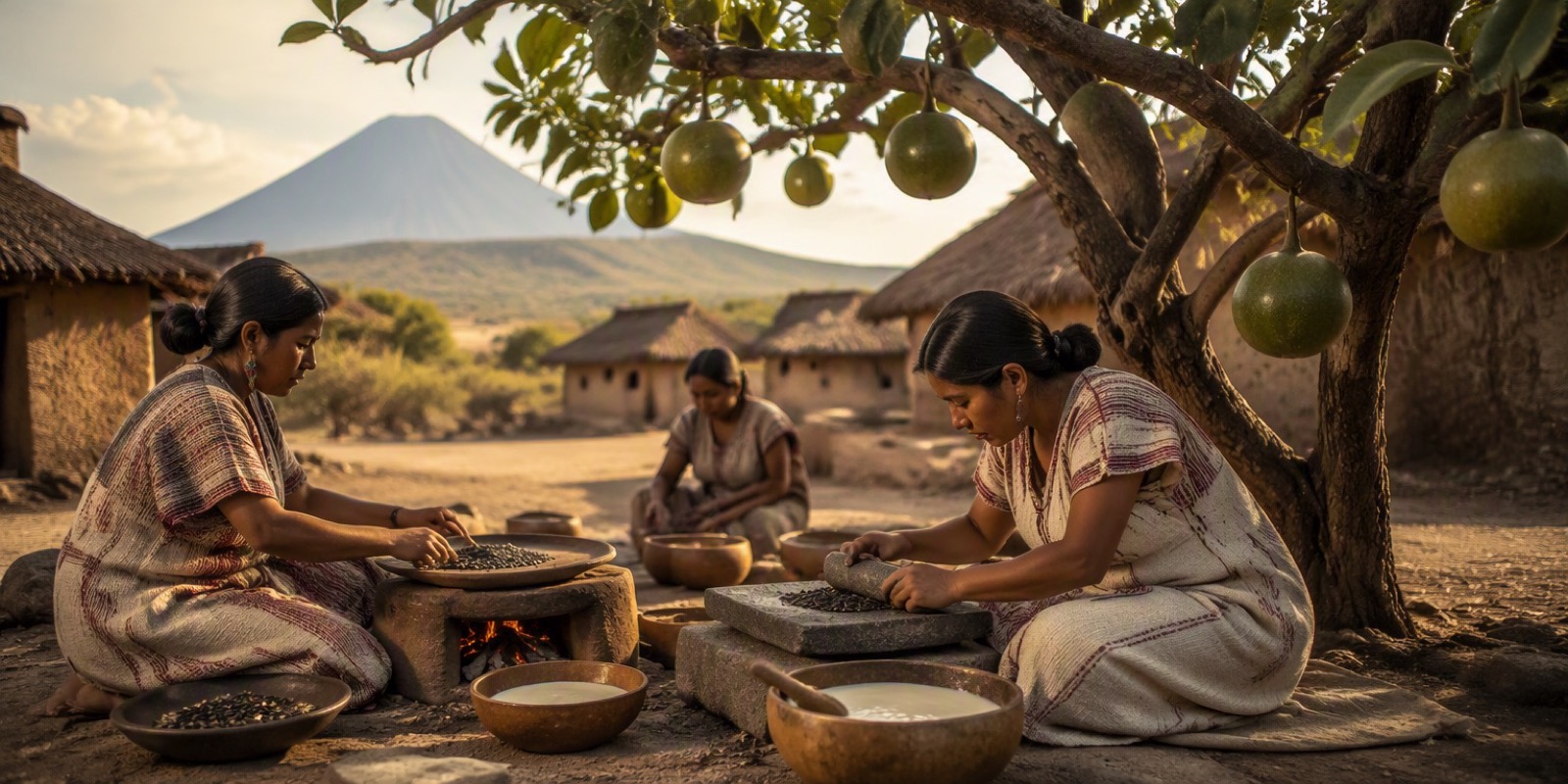
On the hot savannas of Central America's Pacific coast stands a modest tree with an immodest résumé. The jícaro — morro in El Salvador, Crescentia alata to botanists — bears hard, round gourds directly on its trunk, fruits so evocative that the ancient Maya cast one as a human head in their greatest story. Crack the gourd open, though, and you find the real treasure: hundreds of small seeds that become one of the Americas' oldest plant milks.
The Tree That Bears a Head
Few plants in the world carry mythology like the calabash tree. In the Popol Vuh, the K'iche' Maya book of creation, the lords of the underworld defeat the hero Hun Hunahpú and hang his severed head in a barren tree by the road. At once the tree bears fruit — round gourds indistinguishable from the head itself — and from that fruit the skull spits into the hand of the maiden Xquic, fathering the Hero Twins who will avenge him. It is one of Mesoamerica's foundational images: death seeding life. The reverence was practical too. The tree's woody gourds became the jícaras — the drinking cups of the region, still used for cacao and pinolillo today — while its night-opening flowers, pollinated by bats, tie it into an older ecology than agriculture itself. A sacred tree, a cup and a milk, all in one trunk.
Comal, Metate, Milk
Turning a cannonball-hard gourd into a glass of milk is patient work. The fruit is split open and its dark pulp scooped out; the flat, teardrop seeds are washed free of it, dried in the sun, then toasted — traditionally on a clay comal, the same griddle that bakes tortillas — until they release a nutty aroma somewhere between sesame and pumpkin seed. Historically the toasted seeds were ground on a metate, the volcanic-stone quern at the heart of every Mesoamerican kitchen, often alongside rice, cinnamon, cacao or other spices. Blended with water and strained, the paste becomes a naturally milky, tan-coloured drink, and the chemistry explains why: modern analysis finds the seed kernel is roughly 40 per cent protein and nearly as much oil, mostly unsaturated and rich in oleic acid — a seed that was, in effect, always destined to be milk.
A Living National Tradition
Horchata de morro is not a museum piece. In El Salvador it ranks among the emblematic drinks of the national table, ladled from barrels at markets and pupuserías, sold ice-cold in bags with a straw, mixed at home from packets of ground semilla de morro that every Salvadoran shop abroad keeps in stock. In Nicaragua the same seed becomes semilla de jícaro, a chilled drink of toasted jícaro seeds ground with rice and cinnamon, cousin to the cacao-and-maize pinolillo that Nicaraguans drink from jícara gourds — so central to identity that they call themselves pinoleros. Honduras and Guatemala keep their own versions. Recipes have absorbed colonial-era arrivals — rice, vanilla, sugar — but the heart of the glass is still the seed of a tree the region has honoured for a thousand years and more, prepared much as it always was.
A Tale of Two Horchatas
The word horchata sailed from Spain, where Valencia's horchata de chufa — a milk of tiger nuts, itself with roots in the Islamic Mediterranean — takes its name from the Latin hordeata, a barley water. With colonisation the name spread across the Atlantic and settled onto whatever local drink it resembled: in Mexico, largely rice horchata; in Central America, the far older seed drinks of the Pipil, Maya and Nicarao. This is worth saying plainly, because the borrowed label can obscure the lineage. Horchata de morro is not a Spanish recipe adapted with local ingredients; it is an indigenous beverage that predates the word attached to it. The chufa drink of Valencia and the morro drink of Cuscatlán are parallel inventions — two cultures independently discovering that a humble seed, ground with water, becomes something very like milk.
And when his head was put in the fork of the tree, the tree bore fruit... This is the calabash tree, as we call it today, or 'the head of One Hunahpu,' as it is said.Popol Vuh, trans. Dennis Tedlock (1996)
Legacy
Food scientists now study jícaro seed milk as a high-protein, low-glycaemic alternative for the dry tropics — a crop that thrives where dairying struggles. But its real legacy is continuity: a drink recorded in myth before it was recorded in recipe books, still made from the same tree, in the same places, by the descendants of the people who first ground its seeds. Few plant milks anywhere can claim so unbroken a thread.
Key Facts
- Origin
- Mesoamerica (El Salvador, Nicaragua, Honduras, Guatemala)
- Sacred Reference
- The calabash tree of the Popol Vuh
- Botanical Name
- Crescentia alata
- Living Tradition
- Horchata de morro / semilla de jícaro
- Key Nutrients
- Around 40% protein with soya-like amino acids; oils rich in oleic acid
Sources & citations
- Popol Vuh: The Mayan Book of the Dawn of Life, translated by Dennis Tedlock — Simon & Schuster (PDF hosted by University of Wisconsin Oshkosh), 1996
- Physicochemical characterization of jicaro seeds (Crescentia alata H.B.K.): A novel protein and oleaginous seed (Corrales et al., Journal of Food Composition and Analysis 56) — CIRAD Agritrop repository, 2017
- Crescentia alata — Wikipedia, 2025
- Horchata de Morro (Jícaro Horchata) — Bat Week, 2023
- Horchata de Morro - Traditional Salvadoran Recipe — 196 flavors, 2021